Let us know how we can help
Sales & Pricing
Speak to a rep about your business needs

Help & Support
See our product support options
General inquiries and locations
Contact us


 Control-M + RabbitMQ
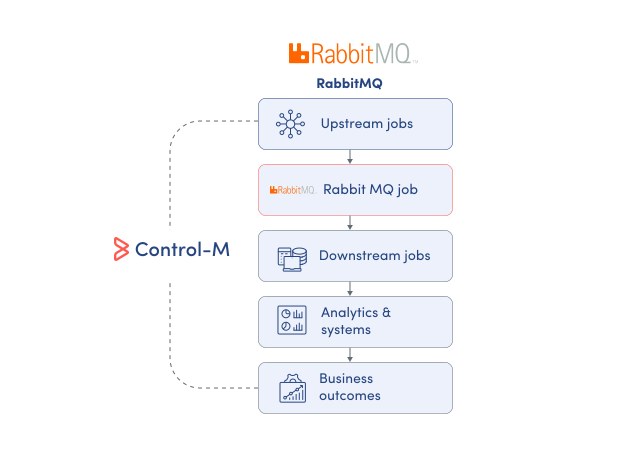
Your RabbitMQ workflow starts before a message publish operation ever executes — and it can fail when something upstream breaks. An Amazon S3 object never arrives. A Kubernetes batch job finishes late. Control-M orchestrates the full chain: file arrival, application processing, RabbitMQ message publication, and downstream service execution.
common workflow issues
Does this sound like your week?
These aren’t edge cases. They’re the normal operating conditions for teams running RabbitMQ messaging workflows across multiple tools. Here’s how Control-M handles each one.
UPSTREAM FAILURE
The 02:00 batch failed. RabbitMQ must not publish its completion message.
Control-M evaluates the upstream job state before running the RabbitMQ job. If processing fails, the publish step remains blocked and downstream dependencies do not advance — preventing a success message from triggering work against incomplete data.
MESSAGE ROUTING
Processing finished. The message still needs the right exchange and routing key.
Control-M defines the RabbitMQ publish action with the target virtual host, exchange, routing key, message encoding, properties, and payload. Publication becomes an explicit, dependency-aware workflow step instead of application-side glue or a disconnected script.
FAILURE RECOVERY
The RabbitMQ endpoint is unavailable when the workflow reaches its publish step.
Control-M detects the unsuccessful job outcome and applies workflow-level recovery actions such as rerun logic, notifications, or downstream holds. Operators see the failure in the same workflow context as the jobs before and after RabbitMQ
QUEUE OPERATIONS
Stale messages remain in a queue before the next controlled processing cycle.
Control-M can run RabbitMQ’s Purge the Queue action against a defined virtual host and queue as an orchestrated job. Sequence it behind required checks and before downstream processing so queue cleanup occurs at the intended workflow point.
SLA RISK
RabbitMQ succeeded. The end-to-end service is still trending late.
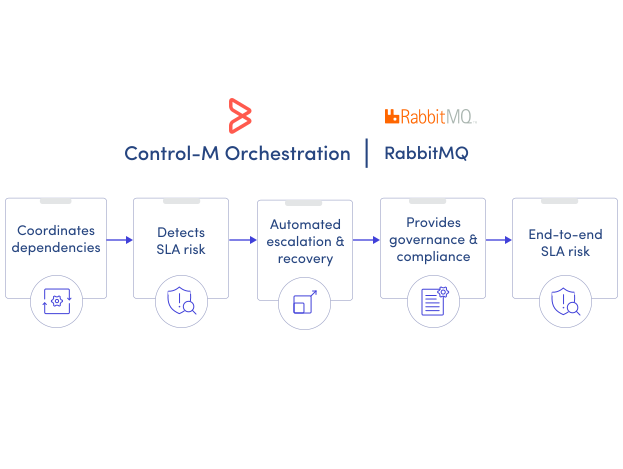
Control-M attaches SLA management to RabbitMQ jobs and evaluates timing across the wider workflow. Predictive SLA monitoring identifies potential delays before the business deadline, helping teams focus remediation on the dependency putting delivery at risk.
Control‑M + RabbitMQ
Control‑M + RabbitMQ
|
API and automation capabilities |
Control-M Automation API · Job:RabbitMQ JSON definitions · centralized connection profiles · Publish a Message · Purge the Queue · vhost targeting · exchange and routing-key configuration · String/Base64 message encoding |
|
Deployment models & infrastructure flexibility |
Control-M SaaS · Control-M self-hosted · Linux Agent · Windows Agent · remote RabbitMQ endpoint connectivity · provisioned RabbitMQ plug-in · hybrid application workflows |
|
Security posture |
centralized RabbitMQ credentials · username/password authentication · external-vault secret retrieval · CyberArk integration · HashiCorp Vault integration · Control-M role authorizations · SAML 2.0/SSO · audit controls |
|
Incident response & MTTR enablement |
RabbitMQ job status monitoring · results and output visibility · Ended Not OK detection · configurable rerun actions · downstream dependency control · SLA delay prediction · automated notifications · PagerDuty workflow integration |
end-to-end orchestration
One production workflow. Every tool in the stack.
Control-M orchestrates workflows across RabbitMQ, Kubernetes, AWS services, databases, file transfers, and downstream applications in a single job flow — with dependency tracking, SLA visibility, and automated recovery across all of them.
- Cross-tool dependency: file arrival → Kubernetes job → RabbitMQ publish → downstream service
- Data-aware triggers: file arrival, API event, job completion, application result
|
RabbitMQ |
message publication · queue purge · exchange targeting · routing-key configuration · job status and output monitoring |
|
Kubernetes |
workload execution · completion tracking · dependency coordination · downstream triggering |
|
Amazon S3 |
file arrival detection · workflow triggering · upstream data readiness |
|
Databases |
SQL execution · stored procedures · data validation · dependency coordination |
|
Control-M MFT |
managed file transfer · file arrival events · transfer status · downstream triggering |
|
PagerDuty |
incident creation · incident updates · failure escalation · response workflow coordination |
|
Downstream applications |
API invocation · dependency sequencing · completion tracking · business workflow handoff |
MONITOR WORKFLOWS
See RabbitMQ in the full workflow context.
RabbitMQ exposes broker and queue-level operational information, but production outcomes often depend on systems outside the broker. Control-M shows RabbitMQ jobs alongside the upstream and downstream work they depend on, giving operators one execution context for troubleshooting:
-
RabbitMQ job status
-
Results and output visibility
-
Cross-tool dependency status
-
Runtime and execution history
-
End-to-end SLA risk
SLA ASSURANCE
Keep RabbitMQ-driven workflows on schedule.
A successful RabbitMQ action does not prove the complete service will finish on time. Control-M tracks RabbitMQ within the end-to-end workflow, evaluates its contribution to the service deadline, and surfaces predicted delays so teams can intervene earlier:
-
SLA breach prediction
-
Critical-path visibility
-
Dependency-aware recovery
-
Proactive operator alerts
-
Business deadline tracking
Documentation
Bring order to complex workflows
Learn how Control-M helps teams orchestrate complex processes with greater visibility, coordination, and control.
