Let us know how we can help
Sales & Pricing
Speak to a rep about your business needs

Help & Support
See our product support options
General inquiries and locations
Contact us


 Control-M + GCP Workflows
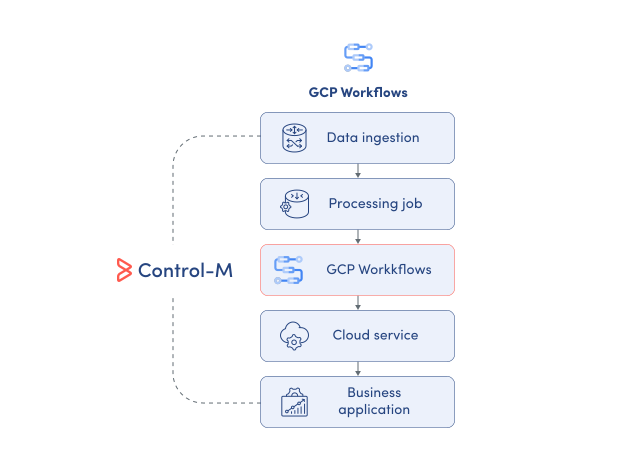
Your GCP Workflows process starts before a workflow execution is ever invoked — and it can fail when something upstream breaks. A Cloud Storage object arrives late. A Cloud Run job misses its processing window. Control-M orchestrates the full chain: Cloud Storage data arrival, Cloud Run processing, GCP Workflows execution, and downstream delivery.
common workflow issues
Does this sound like your week?
These aren’t edge cases. They're the normal operating conditions for teams running AI Inference workflows across multiple tools.
UPSTREAM DEPENDENCY
The Cloud Storage object is late. Your workflow is scheduled anyway.
Control-M coordinates the upstream dependency before releasing the GCP Workflows job, so execution starts only when required conditions are satisfied. The workflow joins the same dependency chain as the rest of production — without another disconnected schedule.
CROSS-TOOL FLOW
Your Cloud Run job finished. The next workflow never started.
Control-M tracks upstream job completion and releases the GCP Workflows job when its defined dependencies are satisfied. Cloud and non-cloud steps stay in one scheduling environment, eliminating manual handoffs and reducing gaps between services.
FAILURE DETECTION
The workflow failed at 2:17 AM. Downstream processing is still waiting.
Control-M monitors GCP Workflows job status, results, and output, then applies defined failure handling before downstream jobs proceed. Operators get the execution context they need while dependency controls prevent the failure from cascading through the production flow.
EXECUTION CONTROL
One transient status check failed. The production chain stopped cold.
Control-M monitors GCP Workflows execution status and applies your defined failure-handling rules, so transient conditions are managed in line with the surrounding production flow rather than triggering false failures. Temporary status-check failures can be absorbed within defined limits, reducing false job failures while preserving controlled handling when the tolerance threshold is exceeded.
SLA RISK
The workflow succeeded. The 7:00 AM business deadline still slipped.
Control-M attaches GCP Workflows execution to the wider service-level flow, where dependencies and deadlines are managed end to end. SLA monitoring exposes delay risk beyond the individual cloud execution, giving operations teams time to act before delivery is late.
Control‑M + GCP Workflows
Control‑M + GCP Workflows
|
Platform & OS coverage |
Control-M SaaS · Linux Agent · Windows Agent · Google Cloud Workflows endpoints · regional GCP workflow execution |
|
Job types supported |
GCP Workflows execution in a specific project and region · runtime arguments (body parameters) · workflow results and output · execution monitoring until completion · cross-application Control-M jobs |
|
SLA monitoring & alerting |
SLA job attachment · service deadline tracking · Control-M predictive SLA analytics · Control-M alerts · dependency-aware escalation |
|
Audit trail & access controls |
secure connection profiles · Service Account authentication · connection to any GCP Workflows endpoint · centralized credential management · Control-M authorization controls |
end-to-end orchestration
One production workflow. Every tool in the stack.
Control-M orchestrates workflows across GCP Workflows, Cloud Storage, Cloud Run, BigQuery, Pub/Sub, Eventarc, and file transfers in a single job flow — with dependency tracking, SLA visibility, and automated recovery across all of them.
- Cross-tool dependency: Cloud Storage → Cloud Run → GCP Workflows → BigQuery → downstream delivery
- Data-aware triggers: file arrival, API event, Pub/Sub message, upstream job completion
|
GCP Workflows |
named workflow execution (project/region) · runtime arguments (body parameters) · status monitoring until completion · results and outputCloud Storage → file arrival coordination · upstream dependency management · downstream workflow release |
|
Cloud Run |
workload orchestration · completion dependencies · production-flow coordination |
|
BigQuery |
query orchestration · dependency management · downstream processing coordination |
|
Pub/Sub |
event-driven workflow coordination · message-based process handoff |
|
Eventarc |
event-driven orchestration · event-to-workflow coordination |
|
File transfers |
managed delivery · arrival dependencies · downstream processing handoff |
MONITOR WORKFLOWS
Monitor GCP Workflows beyond the workflow itself.
GCP Workflows provides execution information for its own workflow runs, but enterprise processes extend across systems before and after them. Control-M centralizes monitoring of GCP Workflows alongside the surrounding production chain, giving operations teams visibility into:
-
Workflow execution status
-
Results and job output
-
Cross-platform dependencies
-
End-to-end execution health
-
SLA risk indicators
SLA ASSURANCE
Keep GCP Workflows business services on schedule.
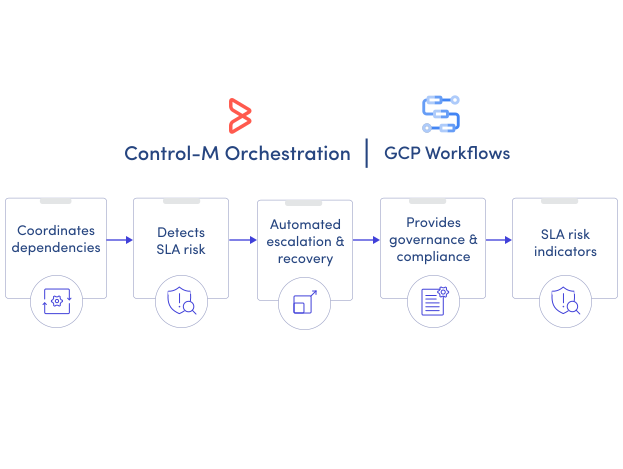
A GCP workflow can complete successfully while the end-to-end business service still misses its deadline. Control-M connects that execution to enterprise SLA management, exposing dependencies and emerging delays across the complete production flow so operations teams can act earlier:
-
SLA job attachment
-
Predictive delay detection
-
Dependency-aware scheduling
-
Proactive operator alerts
-
Business deadline tracking
Documentation
Bring order to complex workflows
Learn how Control-M helps teams orchestrate complex processes with greater visibility, coordination, and control.
