Let us know how we can help
Sales & Pricing
Speak to a rep about your business needs

Help & Support
See our product support options
General inquiries and locations
Contact us


 Control-M + GCP Virtual Machine
Your GCP Virtual Machine workflow starts before a Compute Engine VM lifecycle operation ever executes — and it can fail when something upstream breaks. A Cloud Storage deployment artifact never arrives. A Cloud Build job finishes late and misses the infrastructure window. Control-M orchestrates the full chain: Cloud Storage artifact arrival, Cloud Build image creation, Compute Engine VM provisioning, and deployment handoff.
common workflow issues
Does this sound like your week?
These aren’t edge cases. They’re the normal operating conditions for teams running GCP VM workflows across multiple tools. Here’s how Control‑M handles each one.
DEPENDENCY FAILURE
Your Cloud Build job failed. The VM start must not happen.
Control-M evaluates the upstream job state before releasing the GCP VM operation, keeping the dependent start from running after a failed build. The infrastructure step stays coordinated with the workflow that actually makes it safe to execute.
STATE VERIFICATION
The VM start request succeeded. The instance still isn’t ready.
Control-M polls the GCP VM operation using a configurable verification interval and tolerance, then records the resulting job status. Downstream work can depend on the Control-M job outcome instead of assuming an API request means the infrastructure is ready.
FLEET OPERATIONS
Twenty tagged VMs need to start before the processing window.
Control-M can start, stop, or restart GCP VMs using tags, allowing one workflow step to target multiple matching instances. Platform teams coordinate fleet-level lifecycle actions without building separate scheduling logic around every individual VM.
SLA RISK
A delayed VM operation is putting the 06:00 processing SLA at risk.
Control-M brings the GCP VM job into the same scheduling environment as its upstream and downstream work and lets teams attach an SLA job. Operators can see the infrastructure dependency in the context of the business workflow it supports.
MANUAL LIFECYCLE
The batch finished. Someone still has to stop the Compute Engine VM.
Control-M can make the GCP VM stop operation a downstream workflow step, triggered after the required processing completes. VM lifecycle management becomes part of the production flow instead of a separate console task or manually maintained schedule.
INTEGRATION FACTS
Control‑M + GCP Virtual Machine
|
API and automation capabilities |
create VM · start/stop/reboot/delete · tag-based start/stop/restart |
|
Deployment models & infrastructure flexibility |
Control-M SaaS · Control-M self-managed · Linux Agent · Windows Agent · Google Compute Engine · project and zone targeting · 50 simultaneous GCP VM jobs per Agent |
|
Security posture |
GCP Service Account authentication · IAM authentication · centralized connection profiles · RSA service account key · configurable connection timeout |
|
Incident response & MTTR enablement |
job status monitoring · results and output visibility · configurable verification polling · failure tolerance · dependency-based execution · SLA jobs · downstream workflow coordination |
end-to-end orchestration
One production workflow. Every tool in the stack.
Control-M orchestrates workflows across GCP Virtual Machine, Cloud Storage, Cloud Build, GCP Batch, GCP Workflows, and cloud services in a single job flow — with dependency tracking, SLA visibility, and automated recovery across all of them.
- Cross-tool dependency: Cloud Build → GCP Virtual Machine → GCP Batch → application handoff
- Data-aware triggers: Cloud Storage object arrival, API event, upstream job completion, deployment artifact availability
|
GCP Virtual Machine |
create · start · stop · reboot · delete · tag-based start/stop/restart |
|
GCP Batch |
submit batch jobs · coordinate compute · monitor execution |
|
GCP Workflows |
execute workflows · coordinate dependencies · track completion |
|
GCP Cloud Run |
execute jobs · coordinate services · monitor completion |
|
GCP Functions |
invoke functions · pass parameters · monitor status |
|
GCP Composer |
trigger DAGs · coordinate dependencies · track execution |
MONITOR OPERATIONS
Monitor GCP VM operations in workflow context
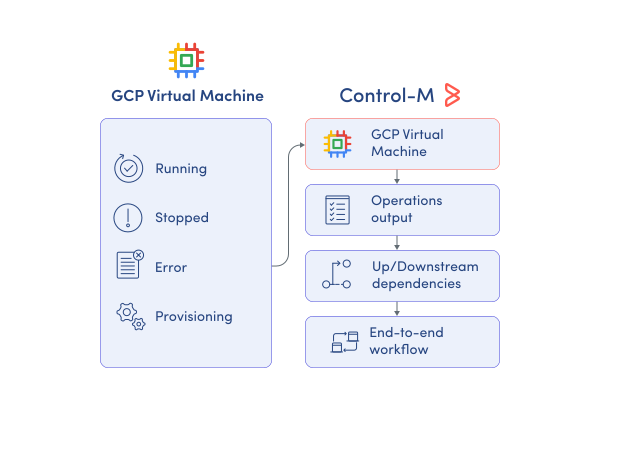
Compute Engine shows infrastructure state, but platform teams also need to know how each lifecycle operation affects the wider production workflow. Control-M monitors GCP VM job status, results, and output alongside surrounding dependencies so operators can see:
-
VM job execution status
-
Operation results and output
-
Upstream and downstream dependencies
-
End-to-end workflow context
SLA ASSURANCE
Keep VM dependencies aligned with production SLAs
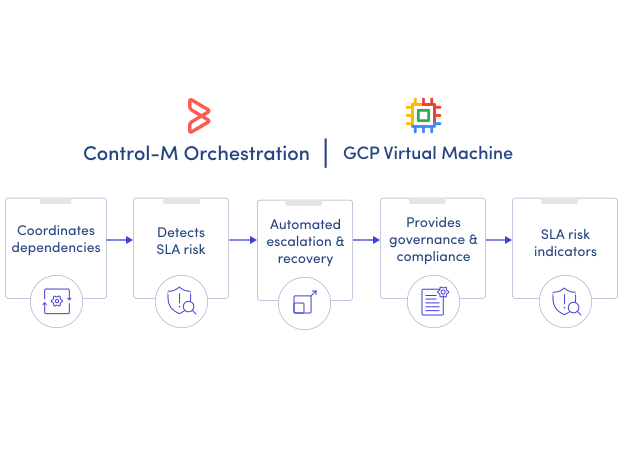
A successful VM operation is only useful when it happens in time for the workload that depends on it. Control-M connects GCP VM jobs to broader scheduling and SLA controls, helping teams coordinate infrastructure with time-sensitive production execution:
-
Attach SLA jobs
-
Coordinate complex job dependencies
-
Apply advanced scheduling criteria
-
Control shared resource usage
Documentation
Bring order to complex workflows
Learn how Control-M helps teams orchestrate complex processes with greater visibility, coordination, and control.
