Let us know how we can help
Sales & Pricing
Speak to a rep about your business needs

Help & Support
See our product support options
General inquiries and locations
Contact us


 Control-M + GCP Dataplex
Your GCP Dataplex workflow starts before a data quality scan ever runs — and it can fail when something upstream breaks. A Cloud Storage dataset arrives incomplete. A BigQuery transformation runs long. Control-M orchestrates the full chain: Cloud Storage ingestion, BigQuery transformation, Dataplex execution, and downstream delivery.
common workflow issues
Does this sound like your week?
These aren’t edge cases. They’re the normal operating conditions for teams running GCP Dataplex jobs across multiple tools. Here’s how Control-M handles each one.
DATA QUALITY
Your BigQuery load finished. The Dataplex quality scan never started.
Control-M models the BigQuery job and Dataplex scan as dependent workflow steps, then starts the predefined scan only after its upstream condition is satisfied. A missed handoff becomes a visible workflow state instead of a silent data-quality gap.
FAILED SCAN
The 2:00 a.m. data quality scan failed. Downstream reporting is waiting.
Control-M monitors Dataplex job status, results, and output, applies defined failure handling, and prevents dependent work from advancing on an unsuccessful run. Operations sees the failed step in context and can recover the workflow without rebuilding the chain.
SPARK DELAY
Your Custom Spark Task ran long. Every downstream dependency shifted.
Control-M monitors the Dataplex task within the end-to-end workflow and tracks its contribution to downstream delivery commitments. SLA monitoring exposes the impact of the delay early, so teams can intervene before a late Spark task becomes a late business outcome.
PROFILE HANDOFF
The profile completed. Your next BigQuery process is still waiting.
Control-M tracks completion of the predefined Data Profiling Scan and evaluates the next workflow dependency automatically. When the required state is reached, downstream processing proceeds without a separate polling script, cron schedule, or manual handoff.
STATUS POLLING
Dataplex is still running. Your scheduler has already assumed failure.
Control-M provides configurable status polling frequency and failure tolerance for GCP Dataplex jobs. Temporary status-check issues can be handled before the job ends Not OK, reducing false failures while keeping the surrounding production workflow under centralized control.
INTEGRATION FACTS
Control‑M + GCP Dataplex
|
workload.types |
Data Quality Task · Custom Spark Task · Data Profiling Scan · Data Quality Scan |
|
trigger.type |
advanced schedule · upstream job completion · file arrival · API/event condition · cross-tool dependency |
|
cross_tool.deps |
Google Cloud Storage · BigQuery · GCP Dataflow · GCP Data Fusion · Apache Airflow/Cloud Composer · downstream analytics |
|
cloud.platforms |
Google Cloud Platform · hybrid environments · multi-cloud workflows · Control-M SaaS · self-hosted Control-M |
|
error_handling |
status polling frequency · failure tolerance · downstream cascade prevention · dependency-based recovery · SLA monitoring · alerts |
|
throughput |
up to 50 Dataplex jobs simultaneously per Agent · centralized scheduling · Resource Pools · Lock Resources |
|
observability |
Dataplex job status · job results · job output · SLA tracking · end-to-end dependency visibility · workflow monitoring |
end-to-end orchestration
One production workflow. Every tool in the stack.
Control-M orchestrates workflows across GCP Dataplex, BigQuery, Cloud Storage, Cloud Composer, Dataflow, and cloud services in a single job flow — with dependency tracking, SLA visibility, and automated recovery across all of them.
- Cross-tool dependency: Cloud Storage → BigQuery → GCP Dataplex → analytics handoff
- Data-aware triggers: file arrival, API event, BigQuery completion, upstream job result
|
GCP Dataplex |
Data Quality Task · Custom Spark Task · Data Profiling Scan · Data Quality Scan · status monitoring |
|
BigQuery |
query execution · transformation dependencies · upstream/downstream sequencing |
|
Cloud Storage |
file arrival · ingestion dependencies · data handoffs |
|
Cloud Composer / Airflow |
DAG orchestration · completion dependencies · cross-DAG workflow coordination |
|
GCP Dataflow |
pipeline execution · status dependencies · downstream sequencing |
|
GCP Data Fusion |
pipeline execution · workflow dependencies · centralized monitoring |
|
Downstream analytics |
delivery dependencies · SLA coordination · workflow completion |
airflow coexistance
Control-M doesn’t replace your Airflow DAGs. It runs the layer above them.
The objection is common: “We’re already on Airflow.” The issue isn’t what Airflow does – it’s what happens before and after Airflow runs. That’s where pipelines actually fail.
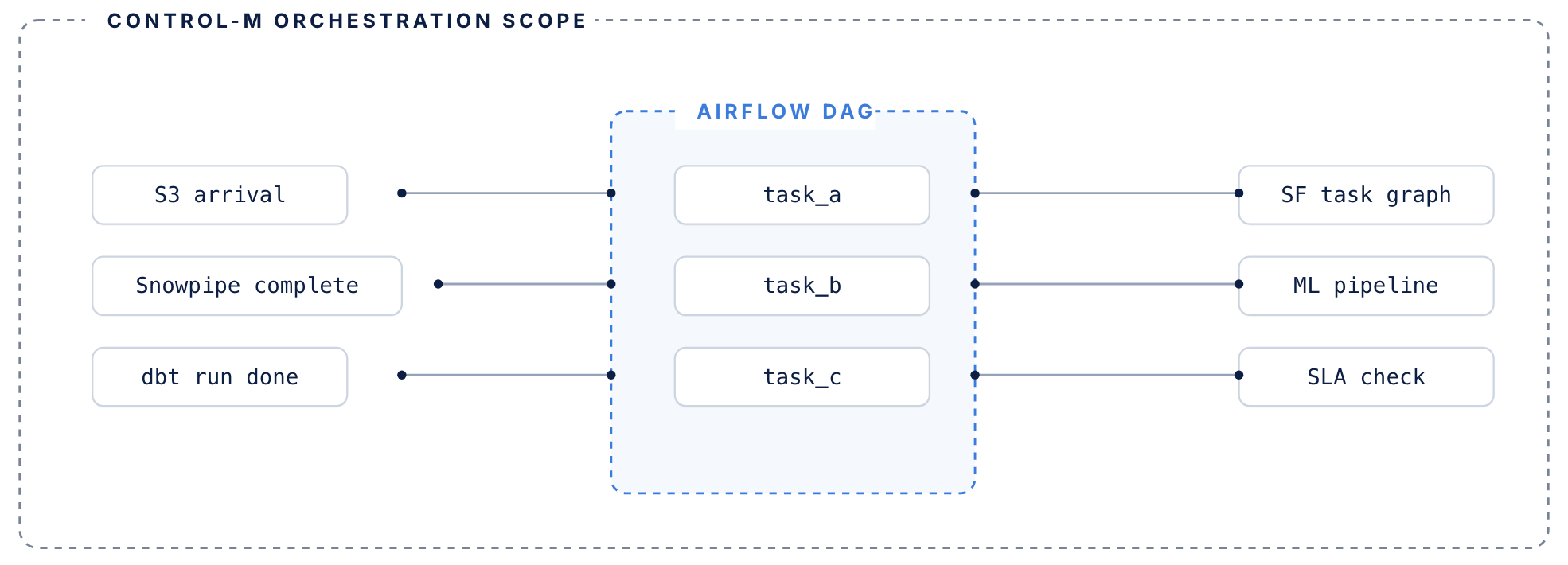
Airflow manages its DAG. Control-M manages everything surrounding it.
airflow handles
DAG-level orchestration inside the data pipeline
- DAG-level task orchestration within data pipelines
- Python operators, sensors, and task dependencies
- Execution graph for jobs that run inside your pipeline
- Manages retries within a single DAG context
control-m adds
The coordination layer around your DAGs
- Coordination layer around DAGs — triggers Airflow based on upstream conditions: file arrivals, API events, other tool completions
- Tracks each DAG’s SLA contribution across the full end-to-end workflow, not just its own routine
- Manages failure recovery when upstream dependencies fail before Airflow even starts
- Existing DAGs don’t need to be rewritten or migrated
MONITOR PIPELINES
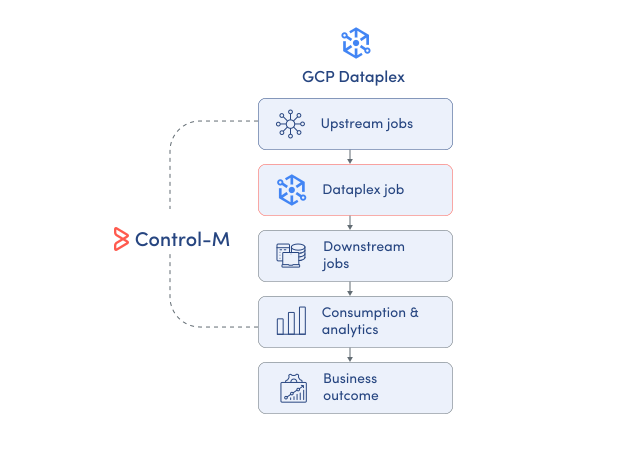
Monitor Dataplex jobs across the full data pipeline.
Dataplex shows execution inside its Google Cloud context; production dependencies often extend beyond it. Control-M provides centralized monitoring of Dataplex status, results, and output alongside the upstream and downstream jobs that determine whether the full workflow succeeds:
-
Dataplex job execution status
-
Job results and output
-
Upstream and downstream dependencies
-
End-to-end workflow monitoring
-
Cross-platform failure context
SLA ASSURANCE
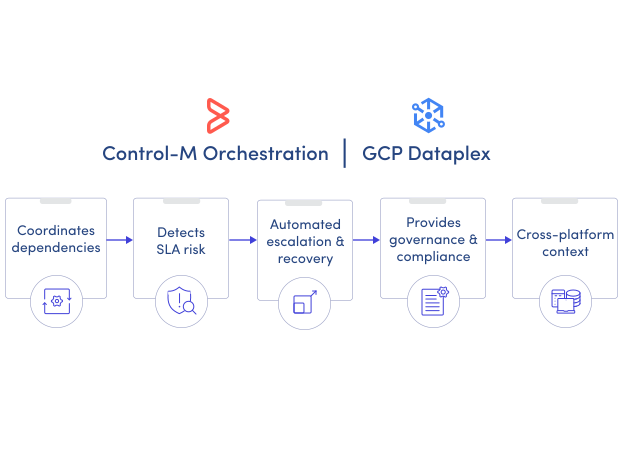
Put Dataplex execution inside the business SLA.
A successful Dataplex scan does not prove the complete data product arrived on time. Control-M attaches SLA management to Dataplex jobs and tracks them within the wider workflow, helping teams identify delays before upstream or downstream dependencies jeopardize delivery:
-
Dataplex SLA job attachment
-
End-to-end SLA tracking
-
Predictive delay visibility
-
Dependency-aware workflow status
-
Centralized operational alerts
Documentation
Bring order to complex workflows
Learn how Control-M helps teams orchestrate complex processes with greater visibility, coordination, and control.
