Let us know how we can help
Sales & Pricing
Speak to a rep about your business needs

Help & Support
See our product support options
General inquiries and locations
Contact us


 Control-M + dbt
Your dbt workflow starts before a transformation job ever executes — and it can fail when something upstream breaks. A Fivetran sync arrives late. A Snowflake load misses its expected completion window. Control-M orchestrates the full chain: coordinating the dbt Cloud job with the source ingestion, warehouse loading, and downstream delivery jobs that surround it — so a transformation only runs when its upstream data is ready.
common workflow issues
Does this sound like your week?
These aren’t edge cases. They’re the normal operating conditions for teams running dbt jobs across multiple tools. Here’s how Control-M handles each one.
DATA ARRIVAL
The Fivetran sync is late. Your dbt job is already scheduled.
Control-M makes upstream completion a condition instead of relying on a clock. It holds the dbt Cloud job until ingestion succeeds, then releases it automatically — preventing transformations from starting against incomplete warehouse data.
RUN FAILURE
Your dbt Cloud run failed — including its tests. Your downstream analytics workflow is still waiting
Control-M monitors dbt job status, results, and output while coordinating dependent workloads. When execution fails, downstream jobs remain gated by workflow conditions, helping teams prevent failed transformations from propagating into reporting and analytics.
CROSS-TOOL HANDOFF
Your dbt job finished. The downstream warehouse process never started.
Control-M places dbt and surrounding jobs in one scheduling environment with explicit dependencies. Successful dbt completion can satisfy the condition for the next workload, removing disconnected schedules and manual handoffs between transformation and downstream processing.
FAILURE RECOVERY
A dbt job failed at 2:13 AM. The pipeline stopped.
Control-M monitors dbt job status, results, and output within the wider workflow. Operators can see the failed execution alongside its dependencies, apply centralized recovery controls, and coordinate the restart without tracing disconnected schedules across tools.
SLA RISK
The 7:00 AM dashboard depends on a dbt run that’s slipping.
Control-M can attach SLA management to dbt jobs and coordinate them with the workflows around them. Data teams gain visibility into delivery timing and dependencies, helping them respond before a delayed transformation affects a business deadline.
INTEGRATION FACTS
Control‑M + dbt
|
workload.types |
dbt Cloud job execution (triggered by job ID) · predefined dbt job commands · overridden dbt job commands |
|
trigger.type |
time schedule · upstream job completion · Control-M conditions · file arrival dependency · cross-platform completion dependency |
|
cross_tool.deps |
data ingestion jobs · Snowflake workloads · Databricks jobs · BigQuery jobs · database jobs · file transfers · downstream analytics |
|
cloud.platforms |
dbt Cloud (triggered by job ID) · Control-M SaaS · self-hosted Control-M |
|
error_handling |
status polling frequency · job status monitoring · results monitoring · output monitoring · downstream dependency control |
|
throughput |
up to 50 simultaneous dbt jobs per Agent · centralized scheduling · configurable status polling frequency · multi-job workflow orchestration |
|
observability |
dbt job status · results · job output · workflow dependencies · SLA management · Control-M job monitoring |
end-to-end orchestration
One production workflow. Every tool in the stack.
Control-M orchestrates workflows across dbt, Snowflake, Databricks, BigQuery, file transfers, and cloud services in a single job flow — with dependency tracking, SLA visibility, and automated recovery across all of them.
- Cross-tool dependency: file ingestion → warehouse load → dbt transformation → analytics handoff
- Data-aware triggers: file arrival, API event, upstream job completion, query result
|
dbt |
job execution · command override · status, results, and output monitoring |
|
Snowflake |
data processing · SQL workloads · workflow dependencies |
|
Databricks |
job execution · workflow coordination · dependency management |
|
BigQuery |
data processing · query jobs · cross-platform coordination |
|
File transfers |
managed movement · arrival dependencies · downstream handoff |
|
Cloud services |
API-driven jobs · workflow dependencies · centralized orchestration |
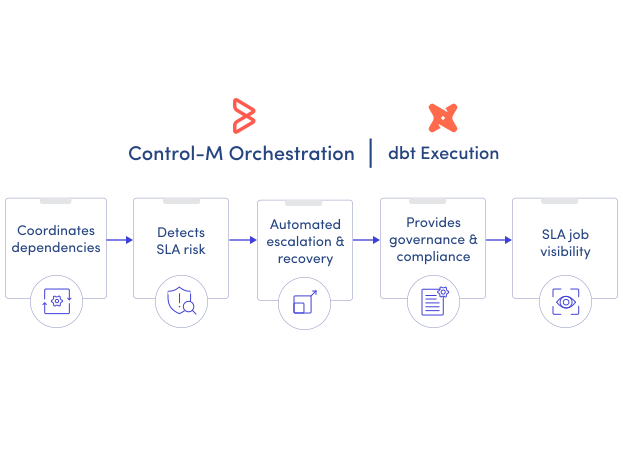
MONITOR PIPELINES
Monitor dbt execution across your complete data pipeline.
dbt reports execution within its own environment, while production delivery depends on workloads across the wider stack. Control-M provides centralized monitoring of dbt jobs and surrounding dependencies, giving data teams operational visibility into:
-
dbt job execution status
-
Job results and output
-
Upstream and downstream dependencies
-
Cross-platform workflow status
-
SLA-related job visibility
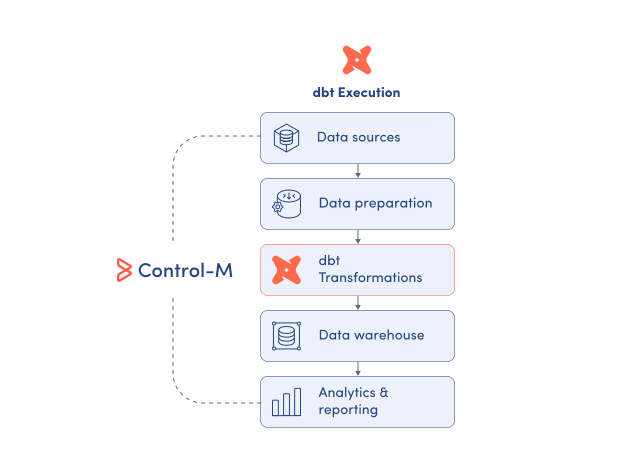
SLA ASSURANCE
Keep dbt transformations aligned with delivery deadlines.
A successful dbt job can still finish too late for the business process it supports. Control-M connects dbt execution to broader workflow dependencies and SLA management, helping teams manage time-sensitive delivery across the pipeline:
-
SLA jobs attached to dbt
-
End-to-end dependency visibility
-
Advanced scheduling criteria
-
Upstream condition management
-
Coordinated downstream execution
Documentation
Bring order to complex workflows
Learn how Control-M helps teams orchestrate complex processes with greater visibility, coordination, and control.
