Let us know how we can help
Sales & Pricing
Speak to a rep about your business needs

Help & Support
See our product support options
General inquiries and locations
Contact us


 Control-M + Azure VM
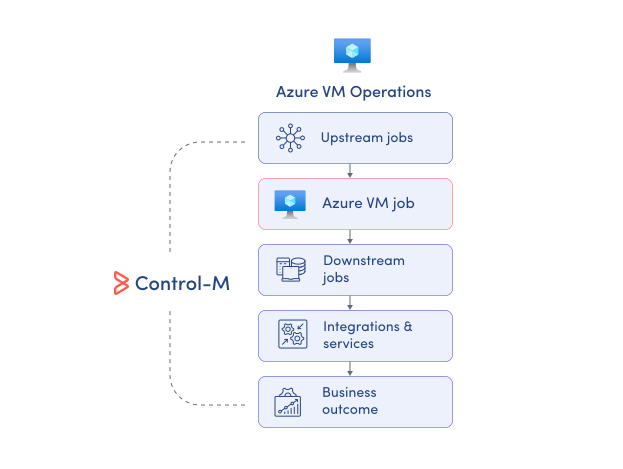
Your Azure VM workflow starts before a virtual machine operation ever executes — and it can fail when something upstream breaks. An Azure Blob Storage delivery arrives late. An Azure Data Factory pipeline misses its expected completion window. Control-M orchestrates the full chain: Azure Blob data arrival, Azure Data Factory processing, Azure VM execution, and downstream delivery.
common workflow issues
Does this sound like your week?
These aren’t edge cases. They’re the normal operating conditions for teams running Azure VM operations across multiple tools. Here’s how Control-M handles each one.
STARTUP DEPENDENCY
Your VM started at 02:00. The workload it needs isn’t ready.
Control-M makes VM startup dependent on actual upstream job completion instead of an isolated clock schedule. It evaluates workflow dependencies before executing the Azure VM Start operation, preventing compute from starting before the production workload is ready.
API THROTTLING
Azure returns HTTP 429. Your infrastructure workflow stops halfway through.
Control-M can detect configured HTTP response codes and rerun the Azure VM job step after a defined interval, with configurable attempts. The connection profile defaults include handling HTTP 429 responses, reducing manual recovery from transient Azure API throttling.
POWER STATE
The downstream job is ready. Its Azure VM is still stopped.
Control-M coordinates the Azure VM Start operation with upstream and downstream workflow dependencies, then verifies execution status before dependent work continues. Infrastructure state becomes part of the production workflow instead of a separate runbook somebody must execute.
FLEET OPERATIONS
Maintenance starts tonight. Dozens of tagged VMs need the same action.
Control-M supports start, stop, and restart operations against Azure VMs selected by tag name and value. Platform teams can coordinate grouped VM lifecycle actions inside the wider workflow instead of maintaining separate scripts for every target VM.
FAILURE VISIBILITY
The VM operation failed. The next production step must not run.
Control-M monitors Azure VM job status, results, and output and keeps the operation inside the end-to-end dependency chain. Failed infrastructure actions remain visible with surrounding workload context, preventing downstream execution from blindly continuing after an unsuccessful VM operation.
INTEGRATION FACTS
Control‑M + Azure VM
|
API and automation capabilities |
Control-M Automation API · REST API · CLI · JSON Jobs-as-Code · Azure VM job type · create/update · delete · deallocate · reset · start · stop · tag-based operations |
|
Deployment models & infrastructure flexibility |
Control-M SaaS · self-hosted Control-M · Linux Agent · Windows Agent · Azure endpoints · centralized connection profiles · 50 concurrent Azure VM jobs per Agent |
|
Security posture |
Service Principal · Managed Identity · Workload Identity · Microsoft Entra ID · Azure RBAC-assigned identity · external vault integration · centralized credential profiles |
|
Incident response & MTTR enablement |
HTTP-code-triggered rerun · configurable rerun interval · configurable retry attempts · verification polling · job status and output monitoring · SLA job attachment |
end-to-end orchestration
One production workflow. Every tool in the stack.
Control-M orchestrates workflows across Azure VM, Azure Blob Storage, Azure Data Factory, Azure Functions, file transfers, and cloud services in a single job flow — with dependency tracking, SLA visibility, and automated recovery across all of them.
- Cross-tool dependency: Azure Blob Storage → Azure Data Factory → Azure VM → application handoff
- Data-aware triggers: file arrival, API event, pipeline completion, job exit status
|
Azure VM |
create/update · start · stop · reset · deallocate · delete · tag-based lifecycle actions |
|
Azure Blob Storage |
file arrival coordination · workflow dependency · downstream triggering |
|
Azure Data Factory |
pipeline orchestration · completion tracking · dependency coordination |
|
Azure Functions |
function execution · workflow dependency · status tracking |
|
Control-M MFT |
secure file transfer · arrival detection · delivery coordination |
|
ServiceNow |
incident workflow · operational escalation · cross-process coordination |
|
Azure cloud services |
cross-service dependencies · scheduling · workflow coordination |
MONITOR OPERATIONS
Monitor Azure VM operations across every dependency.
Azure exposes VM state inside its own platform, but production workflows extend across applications and services. Control-M provides centralized visibility into Azure VM job status, results, output, and surrounding dependencies so teams can monitor the complete execution path:
-
Azure VM job status
-
Job results and output
-
Upstream and downstream dependencies
-
Runtime execution visibility
-
Cross-platform workflow context
SLA ASSURANCE
Keep Azure VM workflows aligned with delivery deadlines.
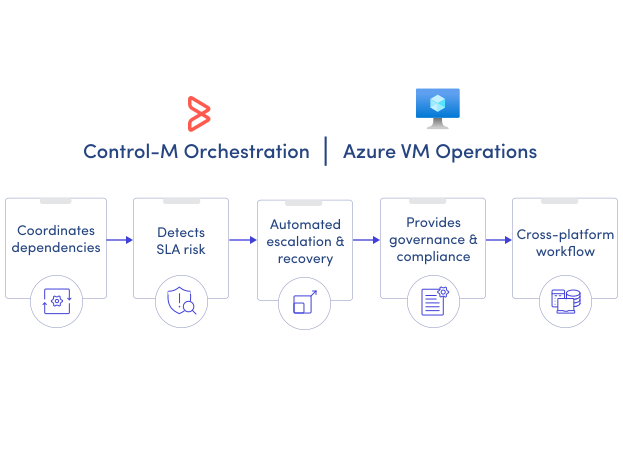
Azure manages the virtual machine operation, but not its contribution to an end-to-end business SLA. Control-M connects infrastructure execution to the wider workflow and can attach SLA management to Azure VM jobs, helping teams detect delivery risk earlier:
-
End-to-end SLA tracking
-
Predictive delay detection
-
Cross-workflow dependency visibility
-
Automated operational alerts
-
Coordinated failure recovery
Documentation
Bring order to complex workflows
Learn how Control-M helps teams orchestrate complex processes with greater visibility, coordination, and control.
