Let us know how we can help
Sales & Pricing
Speak to a rep about your business needs

Help & Support
See our product support options
General inquiries and locations
Contact us


 Control-M + AWS Batch
Your AWS Batch workflow starts before a job queue submission ever reaches a compute environment — and it can fail when something upstream breaks. An object never lands in its Amazon S3 prefix. An AWS Glue ETL job overruns its processing window. Control-M orchestrates the full chain: Amazon S3 data arrival, AWS Glue transformation, AWS Batch execution, and Amazon Redshift delivery.
common workflow issues
Does this sound like your week?
These aren’t edge cases. They’re the normal operating conditions for teams running AWS Batch workloads across multiple tools. Here’s how Control‑M handles each one.
UPSTREAM DEPENDENCIES
Your data landed late. AWS Batch never should have started.
Control-M waits for upstream conditions—including Amazon S3 file arrivals, AWS Glue completion, database updates, or API responses—before launching AWS Batch. Dependency-aware scheduling prevents failed executions, wasted compute resources, and unnecessary reruns.
FAILURE RECOVERY
A compute environment failed. Now half the pipeline is stuck.
Control-M detects AWS Batch job failures, applies configurable retry policies, pauses downstream workflows, and alerts the right teams. Automated recovery prevents cascading failures while preserving workflow integrity and execution visibility.
CROSS-TOOL ORCHESTRATION
AWS Batch finished. Five downstream platforms are still waiting.
Control-M automatically detects successful AWS Batch completion and triggers dependent workflows across data warehouses, analytics platforms, cloud services, file transfers, and APIs—eliminating polling, custom scripts, and manual intervention.
SLA RISK
The overnight batch window is shrinking. You're finding out too late.
Control-M continuously tracks workflow progress against SLAs, predicts potential breaches before they occur, and prioritizes critical workloads. Operations teams gain time to respond before delivery deadlines or downstream processes are affected.
OBSERVABILITY
Jobs succeeded. Nobody knows whether the workflow actually finished.
Control-M provides end-to-end visibility across the complete workflow—not just individual AWS Batch jobs. Teams can trace dependencies, monitor execution status, review audit history, and quickly isolate bottlenecks from a single operational view.
INTEGRATION FACTS
Control‑M + AWS Batch
|
workload.types |
containerized batch jobs · array jobs · multi-node parallel jobs · ETL pipelines · ML inference workloads · HPC workloads · data processing pipelines |
|
trigger.type |
Amazon S3 file arrival · upstream job completion · REST API call · time schedule · manual trigger · job exit status |
|
cross_tool.deps |
AWS Glue job completion · Amazon EMR processing · Apache Airflow DAG trigger · Amazon S3 data delivery · AWS Lambda execution · Amazon Redshift load · REST API workflow |
|
cloud.platforms |
Amazon Web Services (AWS) · Control-M SaaS · Control-M on-premises · hybrid cloud environments |
|
error_handling |
configurable retry count · retry interval · downstream dependency hold · failed job detection · SLA breach alerting · automated recovery · notifications |
|
throughput |
batch processing up to 100 simultaneous jobs per Agent · elastic compute scaling · array job execution · parallel workload processing · dynamic compute environments |
|
observability |
job execution history · dependency lineage · SLA tracking with breach prediction · centralized monitoring · audit logs · Datadog integration · operational dashboards |
end-to-end orchestration
One production workflow. Every tool in the stack.
Control-M orchestrates workflows across AWS Batch, Amazon S3, AWS Glue, Amazon EMR, AWS Lambda, Amazon Redshift, and cloud services in a single job flow—with dependency tracking, SLA visibility, and automated recovery across all of them.
- Cross-tool dependency: Amazon S3 → AWS Glue → AWS Batch → Amazon Redshift → analytics delivery
- Data-aware triggers: Amazon S3 file arrival, EventBridge event, AWS Glue completion, API response
|
AWS Batch |
job submission · dependency orchestration · execution monitoring · exit-state detection · automated retry |
|
Amazon S3 |
file arrival detection · event-driven triggers · dependency validation · secure data handoff |
|
AWS Glue |
job completion trigger · ETL orchestration · dependency management · workflow synchronization |
|
Amazon EMR |
Spark/Hadoop workflow orchestration · status monitoring · downstream job triggering · failure handling |
|
AWS Lambda |
function invocation · event orchestration · API-driven automation · workflow integration |
|
Amazon Redshift |
data load orchestration · SQL execution · dependency tracking · analytics workflow coordination |
|
REST APIs & Web Services |
API invocation · status polling · response validation · cross-platform workflow integration |
AIRFLOW COEXISTENCE
Control‑M doesn’t replace your Airflow DAGs. It runs the layer above them.
The objection is common: “We’re already on Airflow.” The issue isn’t what Airflow does – it’s what happens before and after Airflow runs. That’s where pipelines actually fail.
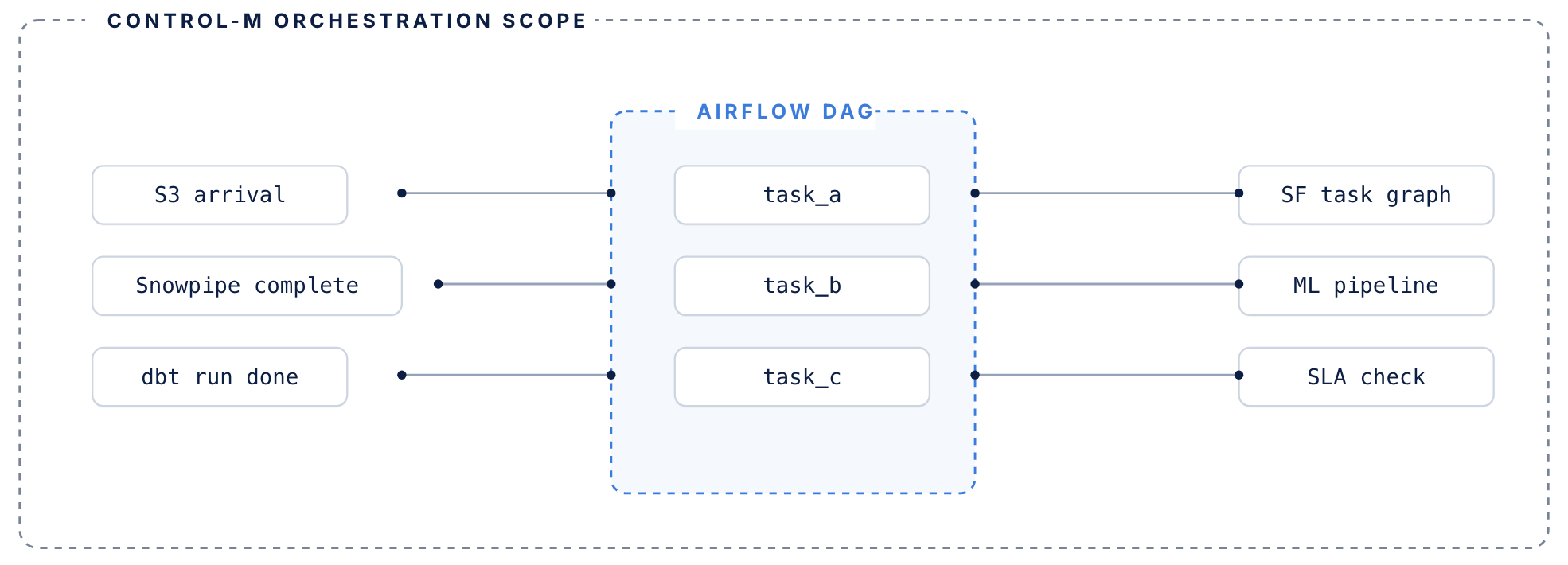
Airflow manages its DAG. Control-M manages everything surrounding it.
airflow handles
DAG-level orchestration inside the data pipeline
- DAG-level task orchestration within data pipelines
- Python operators, sensors, and task dependencies
- Execution graph for jobs that run inside your pipeline
- Manages retries within a single DAG context
control-m adds
The coordination layer around your DAGs
- Coordination layer around DAGs — triggers Airflow based on upstream conditions: file arrivals,
- API events, other tool completions
- Tracks each DAG’s SLA contribution across the full end-to-end workflow, not just its own routine
- Manages failure recovery when upstream dependencies fail before Airflow even starts
- Existing DAGs don’t need to be rewritten or migrated
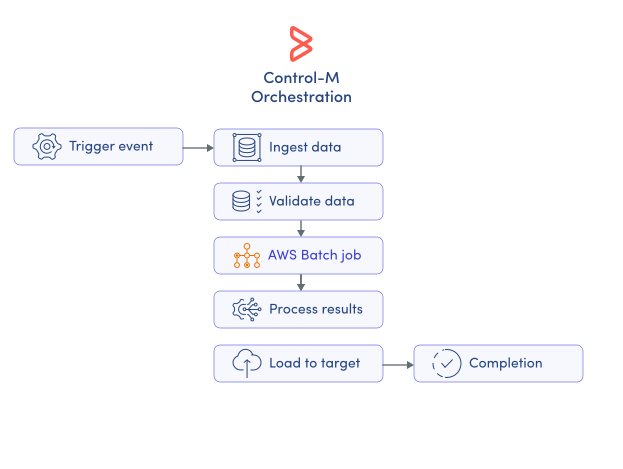
MONITOR WORKFLOWS
Monitor AWS Batch execution across every dependent workflow.
AWS Batch provides execution status for individual jobs, but production workflows typically span multiple platforms and dependencies. Control-M delivers a centralized operational view that tracks every stage of the workflow from trigger to completion, including:
-
End-to-end workflow visibility
-
Job runtime and history
-
Upstream and downstream dependencies
-
SLA status and predictions
-
Centralized operational dashboard
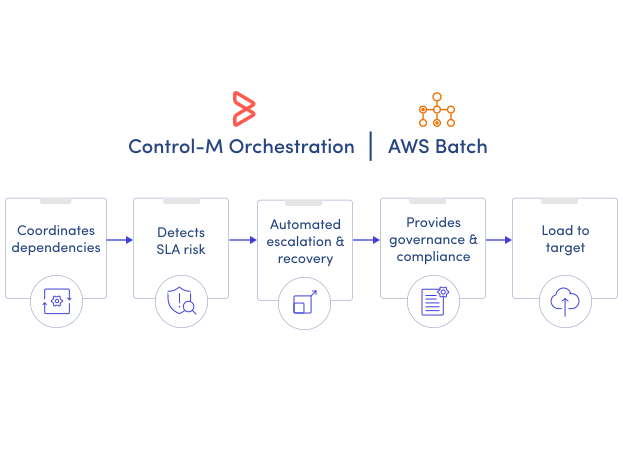
AUTOMATE RECOVERY
Recover AWS Batch workflows before failures impact downstream systems.
AWS Batch reports job execution status, but coordinating retries and downstream recovery across multiple services requires additional orchestration. Control-M automatically detects failures, applies recovery policies, protects dependent workloads, and keeps production pipelines moving through:
-
Configurable retry policies
-
Dependency-aware recovery
-
Downstream job protection
-
Automated alert notifications
-
Failure root-cause visibility
Documentation
Bring order to complex workflows
Learn how Control-M helps teams orchestrate complex processes with greater visibility, coordination, and control.
