


Enterprise Automation has entered the AI era
For decades, automation focused on making predictable processes faster and more reliable. That remains essential, but it is no longer enough.
Enterprises must now orchestrate applications, data, and AI across increasingly complex hybrid environments, without compromising security, resilience, or human control.
Against this backdrop, I am proud that BMC has been named a Leader in the 2026 Gartner® Magic Quadrant™ for Service Orchestration and Automation Platforms for the third consecutive year.
More significant than recognition alone is our year-over-year progress. BMC advanced meaningfully in both Ability to Execute and Completeness of Vision. We believe this reflects the strength of our strategy, disciplined execution, and sustained investment in Control-M.
It also demonstrates that BMC is not simply responding to the changing technology landscape. We are helping shape it, building the orchestration capabilities enterprises will need as AI moves from experimentation into production.
One platform across applications, data, and AI
The world’s largest organizations depend on thousands of interconnected workflows spanning mainframes, distributed systems, cloud services, enterprise applications, data pipelines, AI models, and autonomous agents.
The challenge is no longer automating an isolated task or scheduling a single workload. Enterprises must orchestrate the entire flow of work and data with visibility, speed, and control.
Control-M provides that foundation.
It spans mainframe, distributed, cloud-native, AI/ML, and data-pipeline environments. Customers can deploy it as SaaS, in their own cloud environments, or on premises. That flexibility matters because global enterprises are not moving uniformly toward a single operating model. They must modernize without disrupting the critical systems on which their businesses depend.
But the next phase of orchestration requires us to go further.
A production-grade control plane for agentic AI
AI agents introduce a fundamentally different form of automation.
Traditional automation follows predetermined rules. AI agents can interpret information,make decisions, and initiate actions dynamically. That creates enormous opportunity, but also new risks. Enterprises need to understand what an agent is doing, which data it is using, which systems it can access, and when human approval is required.
Gartner identified BMC’s agentic AI innovation as a strength. Control-M is being positioned as a production-grade control plane through which AI agents and copilots can discover and execute enterprise automation tasks within defined access and governance constraints.
Our expanding investment includes Jett AI Advisor, native Model Context Protocol server capabilities, and deeper partnerships with AWS and SAP.
Our intent is clear: enable enterprises to put AI agents to work within their most important operations without surrendering control.
Through Control-M, agentic AI and large language model tasks can be executed as observable, governed jobs. Role-based access controls define authority. Audit trails create accountability. Service-level requirements protect operational performance. Human-in the-loop approvals provide oversight before consequential actions occur.
For enterprise AI, intelligence alone is not enough. Execution must also be secure, observable, and accountable.
Protecting the data that powers AI
Every AI outcome depends on the quality of the data behind it.
Gartner cited Control-M’s data-pipeline assurance as a strength. Control-M embeds data quality validation directly into the execution layer rather than relying on custom scripts or separate testing tools.
Customers can establish validation rules, apply severity-based gates, and maintain dataset-level visibility within the orchestration platform. If data fails to meet the required standard, Control-M can prevent it from progressing into downstream workflows, analytics, or AI/ML models.
This turns data quality from a retrospective exercise into active operational control.
As enterprises expand their use of AI, data orchestration must address not only whether a pipeline ran, but whether its output can be trusted.
Governance designed into the workflow
Gartner also recognized BMC’s intelligent automation governance.
Control-M routes AI interactions through its native MCP server and runtime gateway, applying the same enterprise controls used for other mission-critical workflows.
This enables organizations to execute nondeterministic AI and LLM tasks within observable orchestration jobs, with access controls, auditability, security guardrails, service levels, and human approvals before state-changing actions occur.
Governance should not be added after AI has been deployed. It must be embedded in how AI work is initiated, executed, and monitored.
That is the role we believe Control-M can play: connecting the flexibility of AI with the operational discipline the enterprise requires.
Customer trust remains the most important measure
Recognition from Gartner is important. Customer trust matters even more.
More than 110 customers shared their experiences through Gartner Peer Insights™, awarding Control-M an average rating of 4.5 out of 5 stars—with more than twice the number of reviews received by our closest competitor.
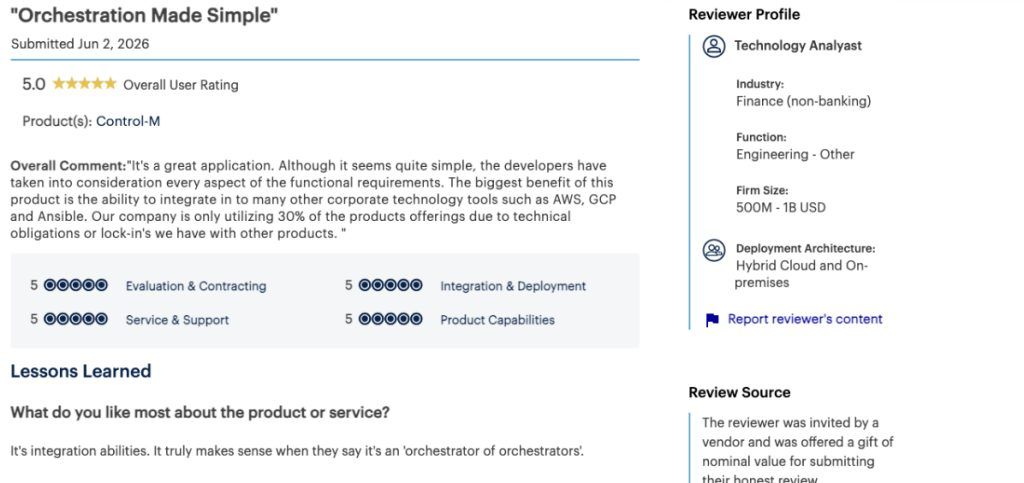
To every customer who provided a review: thank you.
We never take your trust for granted. Your feedback tells us where we are delivering value, where we must improve, and where we should invest next. It pushes us to maintain the reliability customers expect from Control-M while accelerating the innovation they need from BMC.
Our customers consistently tell us they want greater simplicity without less control, faster innovation without greater risk, and AI that can operate confidently at enterprise scale.
Those priorities continue to shape our roadmap.
Progress built by our people
Our year-over-year progress and continued recognition as a Leader belong to our people across BMC.
They reflect the commitment and execution of our teams in Product, Engineering, Sales, Marketing, Customer Success, Support, and Operations.
Building mission-critical enterprise software takes more than a strong product. It requires disciplined execution across the entire customer experience and a determination to keep improving.
I am grateful to our teams for the standards they set and the accountability they bring to serving our customers every day.
What comes next
We are proud of our progress, but the more important question is what our customers will need next.
Applications, data, and AI are converging into a single operational environment. Enterprises will need a control plane capable of coordinating that environment while preserving visibility, governance, and human accountability.
Over the coming months, we will introduce the next wave of Control-M innovation—expanding how enterprises orchestrate data pipelines, operationalize AI agents, and govern increasingly dynamic workflows at scale.
Our position in the 2026 Magic Quadrant reflects the progress we have made. Our focus now is to deliver what our customers will need next.
Read the 2026 Gartner® Magic Quadrant™ for Service Orchestration and Automation Platforms
BMC named a Leader in 2026 Gartner® Magic Quadrant™ for Service Orchestration and Automation Platforms

These postings are my own and do not necessarily represent BMC's position, strategies, or opinion.
See an error or have a suggestion? Please let us know by emailing blogs@bmc.com.
![Blue purple gradient charts and screens_1400x700[2]](https://s7280.pcdn.co/wp-content/uploads/2022/04/Blue-purple-gradient-charts-and-screens_1400x7002-145x100.png)