Let us know how we can help
Sales & Pricing
Speak to a rep about your business needs

Help & Support
See our product support options
General inquiries and locations
Contact us


Financial Close Orchestration for Faster, Low-Risk Close Cycles
Orchestrate financial close, EOD, and BOD workflows with predictability, auditability, and no disruption to systems of record.
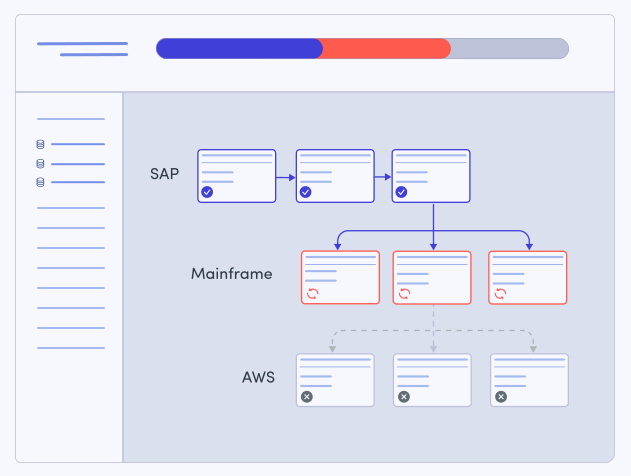
Financial close risk doesn’t come from individual systems. It comes from the gaps between them.
EOD, close, and BOD run as one connected process across SAP, mainframe, and cloud environments, but most tools only manage pieces of that process.
Orchestration platforms like Control‑M make those cross-system dependencies visible and manageable, so teams can run financial close predictably without changing systems of record.
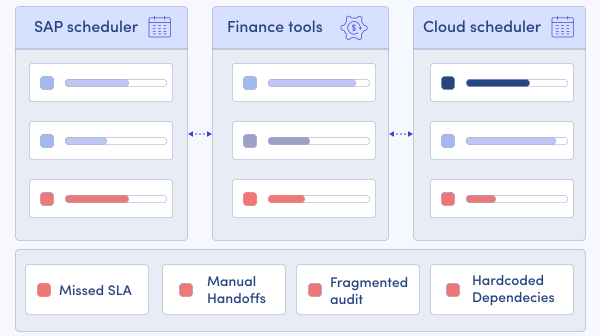
What Existing Tools Miss in Cross-System Financial Close
Financial close is often managed with platform-native schedulers, task checklists, or finance-specific close tools. These approaches work within systems, but not across them.
Common limitations include:
-
Native schedulers only see their own platform
-
Cross system handoffs are hard coded, brittle, or handled out of band
-
SLAs are monitored after they’re missed
-
Audit evidence is fragmented across tools and teams
Takeaway: Closing faster matters less than closing predictably. And predictability breaks at system boundaries.
What Cross-System Orchestration Looks Like at Scale
This example focuses on pre-market reporting, but demonstrates the orchestration, SLA management, and auditability required for financial close.
The Problem: Keeping Time-Critical Work on Track as Volume Climbs
Company growth and the rapid rollout of new business services strained Raymond James Financial’s highly automated workflows. Hundreds of thousands of reports had to be delivered before market open, and one application alone drove nearly 40% of daily workflows. The team needed a way to scale without missing SLAs or creating compliance risk.
What Changed: Centralizing Control and Reducing Workload Complexity
Raymond James standardized on Control‑M to manage workflows across 700+ applications, giving teams clear visibility into dependencies and execution. File transfers were consolidated, and business users gained self-service tools to run and monitor their own workflows. Cyclical processing reduced job volume by grouping repeat transfers, improving throughput and making issues easier to recover from.
The Result: More Throughput, Less Overhead
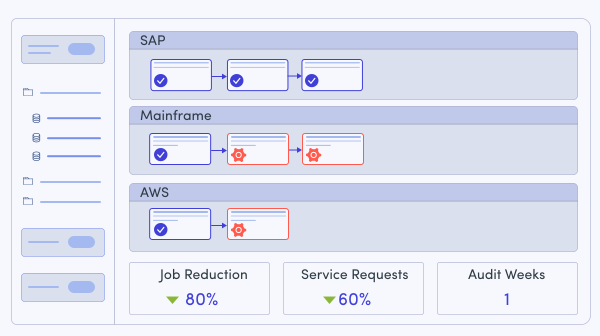
The team scaled workflow volume without adding operational strain. Individual file transfer jobs dropped by 80%, service requests fell by 60%, and audit prep time was reduced from weeks to one day.

Chris Haynes
associate director of IT operations services at Raymond James Financial.
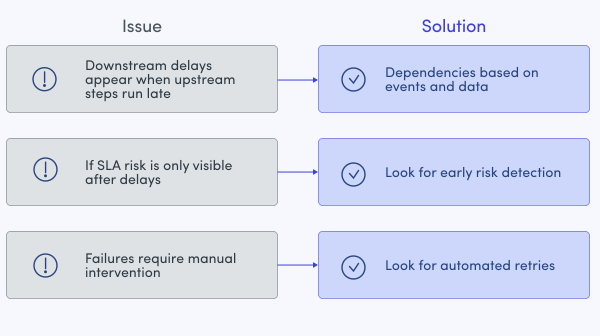
How to Evaluate Financial Close Orchestration at Scale
To manage financial close predictably across systems, look for how orchestration handles the points where delays and risk actually arise:
-
If workflows rely on fixed schedules and downstream delays occur when upstream steps run late
Then look for dependencies that should progress based on events and data readiness
-
If visibility stops at system boundaries and downstream impact is hard to trace
If visibility stops at system boundaries and downstream impact is hard to trace
-
If SLA risk only becomes visible after delays occur
Then look for early risk detection before downstream processes are impacted
-
If failures require manual intervention and delays compound during recovery
Then look for automated retries and recovery for common failure scenarios
-
If audit evidence is spread across systems and reconciliation is manual
Then look for centralized audit evidence, even when execution remains distributed
How Control-M Meets These Financial Close Orchestration Requirements
Control‑M addresses these requirements across three key capabilities:
Event Driven EOD, Close, and BOD Coordination
Control-M advances workflows based on actual completion and data readiness, not fixed schedules—across SAP, mainframe, distributed systems, and cloud services.
End to End Visibility with Predictive SLA Control
Teams see financial close as a single process, with visibility into dependencies, downstream impact, and SLA risk before delays spread.
Centralized Control Without Changing Execution
Jobs continue to run on systems of record. Control-M centralizes orchestration logic, access control, and audit trails without disrupting execution.
Orchestrating Financial Close Across SAP and AWS Environments
In most environments:
- SAP remains the system of record for financial close
- AWS supports downstream reconciliation, reporting, analytics, and regulatory workloads
These processes operate as a single financial close workflow but are typically managed across separate systems.
How Control‑M connects SAP and AWS workflows
Control‑M orchestrates SAP and AWS as one end‑to‑end financial close process, without forcing architectural change.
With Control‑M, teams can:
- Coordinate SAP and AWS workflows in one place—SAP close steps and AWS-based processing run as a single, dependency-aware workflow
- Trigger downstream processes based on real events—AWS workflows start when SAP steps complete or when required data becomes available
- Track SLA risk across system boundaries—Teams see how delays in SAP impact downstream AWS processes before issues spread
- Maintain a centralized audit trail across environments—Execution remains distributed, but visibility, control, and auditability are unified
This allows SAP-based financial close processes to extend into AWS incrementally, without reengineering SAP or fragmenting orchestration across multiple tools.
Common Questions About SAP, AWS, and Financial Close Orchestration
Do I need to replace SAP job scheduling to use Control‑M?

Can SAP trigger workflows in AWS?
Do we need to redesign our SAP financial close processes?
How does Control‑M track SLA risk across SAP and AWS?
How does orchestration across SAP and AWS improve audit readiness?
Common Questions About SAP, AWS, and Financial Close Orchestration
Do I need to replace SAP job scheduling to use Control‑M?
Can SAP trigger workflows in AWS?
Do we need to redesign our SAP financial close processes?
How does Control‑M track SLA risk across SAP and AWS?
How does orchestration across SAP and AWS improve audit readiness?
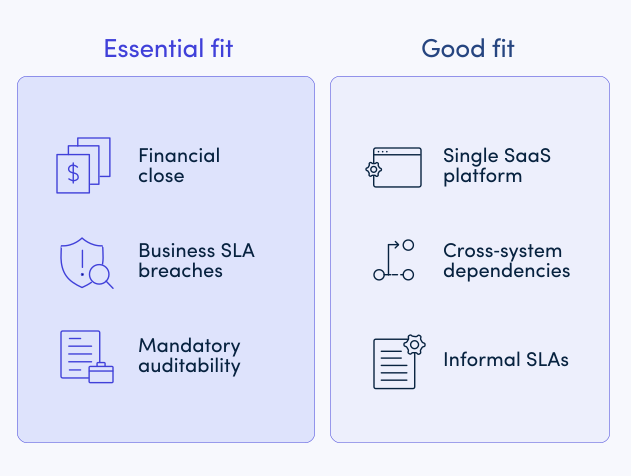
Where Control‑M Fits Best for Financial Close
Control-M is a good fit when:
- Financial close spans SAP, mainframe, distributed, and cloud platforms
- SLA breaches have business or regulatory impact
- Auditability and traceability are mandatory
- Execution must remain distributed by design
Control-M may be less critical when:
- Financial close runs entirely within a single SaaS platform
- There are minimal cross‑system dependencies
- SLAs are informal or non‑binding
Control-M vs. Task-Based Financial Close Automation Tools
| Capability | Task / Checklist Tools | Control-M |
|---|---|---|
| Workflow visibility | Step level | End to end |
| Platform scope | Single system | Hybrid & multi cloud |
| SLA management | Reactive | Predictive |
| Failure recovery | Manual | Automated |
| Audit readiness | Fragmented | Centralized |