Let us know how we can help
Sales & Pricing
Speak to a rep about your business needs

Help & Support
See our product support options
General inquiries and locations
Contact us


The Buyer’s Guide to Workflow Orchestration
A comprehensive comparison.
Introduction
When a “good enough” scheduler no longer cuts it
Workflows no longer live in one place. They stretch across hybrid cloud and on-premises environments to various applications, systems, and data platforms that each have their own schedulers and automation capabilities. If you work in DataOps, you know how fragile this setup can be. A failure in one system can ripple through others, stalling analytics, disrupting production, and eroding trust across teams.
As your workloads grow, your sprawl challenges only get worse. Costs and complexity multiply, and “good enough” tools no longer cut it. Older systems can’t keep up with today’s data volumes, making it hard to maintain visibility and performance. When failures start to impact your operations and customers, it’s natural to wonder: is this tool helping us grow or is it holding us back?
This guide helps you evaluate modern orchestration solutions—so you can move past the patchwork of disconnected tools. You’ll also learn how organizations rely on BMC’s decades of experience running mission-critical workflows to achieve reliable orchestration
1 in 3
Organization
say tool complexity and too many tools cause confusion and inconsistent practices
87%
of enterprises
say digital transformation requires more from their scheduling and workload automation than current tools can deliver

Decision fatigue
Three reasons teams struggle to choose an orchestration platform
- Orchestration projects often start with clear goals but lose momentum during evaluation.
- The market is crowded, and hype makes it hard to tell which solutions deliver.
-
Hard to understand true value
When every vendor promotes different “must- have” features, it’s tough to tell what really matters. Free trials often hide limitations, making it harder to assess long-term value.
-
Not enough clarity to compare
Without a clear evaluation framework, it’s nearly impossible to compare platforms on equal terms.
-
Uncertain results
Even strong contenders raise doubts. You won’t know how a platform will perform in production until it’s already in place.
Go beyond scheduling with orchestration
Many organizations begin their automation journeys with schedulers that run individual jobs or scripts at set times. This approach works for isolated tasks, but as systems multiply, the limitations show. Each scheduler knows only its own jobs, not how they connect to others.
Orchestration advances scheduling by coordinating end-to-end workflows across systems, applications, and data environments. It manages dependencies, tracks service level agreements (SLAs), and enforces governance to provide the context you need to keep processes running smoothly.
Orchestration isn’t just “get jobs to run.” It delivers business outcomes reliably and at scale, even in complex, hybrid environments.
7 capabilities
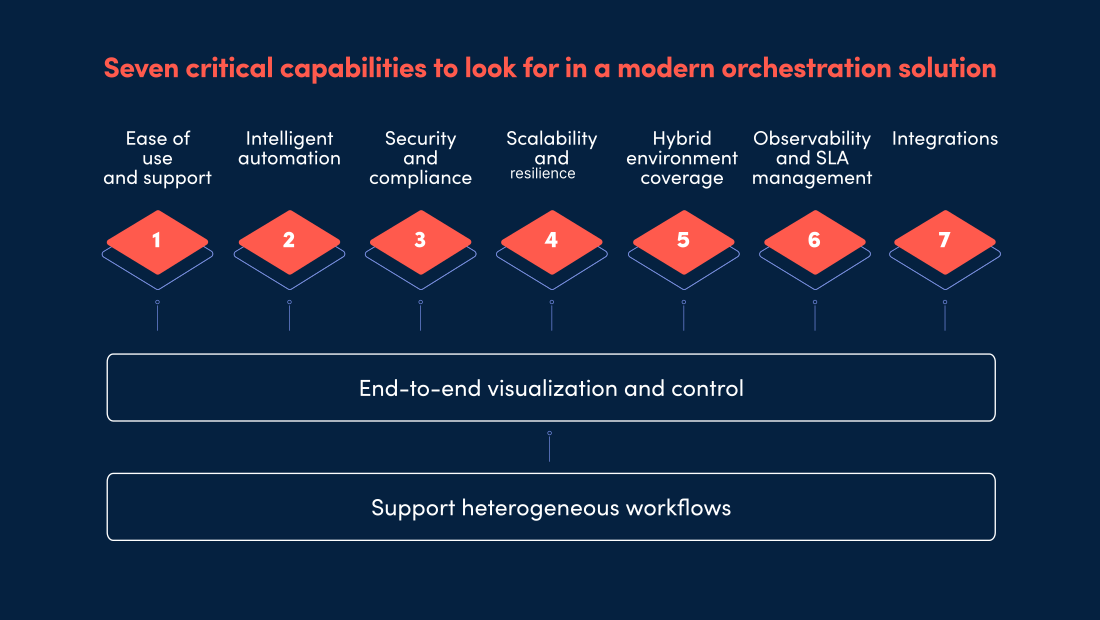
Seven critical capabilities to look for in a modern orchestration solution
Selecting the right orchestration platform starts with knowing which capabilities matter most. The right solution should give you confidence that workflows will run reliably as your environment scales.
1
Ease of use and support
Your platform should make it easy for users to build and manage workflows. A low- code/no-code interface and responsive onboarding can reduce learning curves and speed adoption.
2
Intelligent automation
AI features, like assistants, help users design, troubleshoot, and optimize workflows without the hassle of manual configuration.
3
Security and compliance
Choose a platform that complies with regulations like SOX, HIPAA, and GDPR with role-based access controls, audit trails, zero-trust policies, and workflow-level encryption.
4
Scalability and resilience
Enterprise-grade orchestration should be able to handle modest to millions of workflows daily, with high availability, failover, and automatic recovery to maintain uptime.
5
Hybrid environment coverage
Your platform should unify legacy, on-premises, and cloud environments while supporting highly-regulated data. It should also span platforms and applications, including ERPs and data warehouses, to reduce tool sprawl.
6
Observability and SLA management
Real-time visibility, SLA dashboards, and proactive alerts help prevent disruptions. Impact analysis shows the effect of slow or failed workflows so you can act before violations occur.
7
Integrations
The ideal platform should integrate seamlessly into your DevOps and DataOps ecosystems with connectors for key applications and CI/CD pipelines, plus Jobs-as-Code and GitOps support.
Choosing the right platform
How to choose an orchestration platform
Now that you know what to look for, here's how to make the right choice:
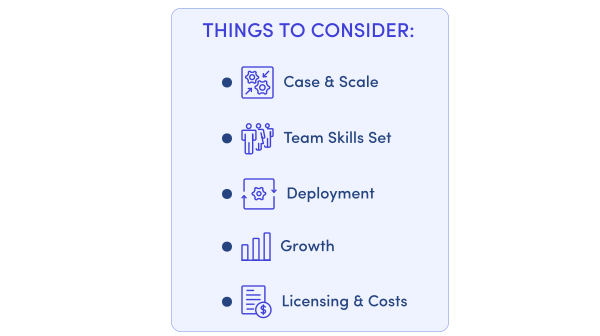
Consider your use case and scale: Start by mapping where orchestration will add the most value, like data pipelines or IT operations. Then, define the workflows, dependencies, and data sources you need to manage.
Evaluate your team’s skill set: Your platform is only as effective as the people using it. Plan for both business users who need low-code tools and developers who rely on APIs that integrate with their preferred tools.
Explore your deployment options: Decide where you’ll host your platform. On-premises may offer tighter control for regulated or mainframe environments, while cloud or hybrid deployments can simplify management.
Plan for future growth: Your needs will change as your data and systems grow. Choose a platform that scales without major rework and supports new integrations through open frameworks or modular add-ons.
Account for licensing and long-term costs: Platforms charge per agent, job, workflow, or by consumption. Choose flexible licensing to support growth, and factor in your total cost of ownership, as maintenance and upgrades quickly add up.
CASE STUDY

Data pipeline orchestration is the secret sauce for Domino’s Pizza
Domino’s relies on Control-M to orchestrate thousands of data workflows across its evolving tech stack.
Impact:
- 3,000 data pipelines orchestrated2
- Improved SLA performance
- Faster delivery of critical reports

“Control-M is mission-critical to Domino’s data-driven culture. It’s going to play a key role in helping us continue to grow and deliver cutting-edge innovation.”
Deepti Soni, Sr. IT Manager of Data Quality, Data Operations, and MLOps, Domino’s Pizza
a side-by-side look at leading solutions
How the top workflow orchestration platforms stack up
Gartner names BMC (Control-M), Redwood Software, and Stonebranch as Leaders in the August 2026 Gartner® Magic Quadrant™ for Service Orchestration and Automation Platforms. See how the three compare below.

RunMyJobs
(Redwood)

Stonebranch
(UAC)

Control-M
(BMC)
RunMyJobs
(Redwood)
REVIEW SCORES
Stonebranch
(UAC)
REVIEW SCORES
REVIEW EXTRACTS (POSITIVE)
- “Redwood provides the workload automation solution for delivery as SaaS.”
(TrustRadius)
REVIEW EXTRACTS (POSITIVE)
- “Easy to use. The interface is clean and helps us manage workflows without a lot of effort.”
(G2)
REVIEW EXTRACTS (POSITIVE)
- “Control-M tracks data at every step, checks conditions, retries intelligently, and if something goes wrong, it tells us where and why. It basically keeps the wheels turning behind the scenes without us needing a million scripts duct-taped together.”
(TrustRadius)
RunMyJobs
(Redwood)
REVIEW EXTRACTS (POSITIVE)
- “Redwood provides the workload automation solution for delivery as SaaS.”
(TrustRadius)
Stonebranch
(UAC)
REVIEW EXTRACTS (POSITIVE)
- “Easy to use. The interface is clean and helps us manage workflows without a lot of effort.”
(G2)
Control-M
(BMC)
REVIEW EXTRACTS (POSITIVE)
- “Control-M tracks data at every step, checks conditions, retries intelligently, and if something goes wrong, it tells us where and why. It basically keeps the wheels turning behind the scenes without us needing a million scripts duct-taped together.”
(TrustRadius)
REVIEW EXTRACTS (NEGATIVE)
- “It lacks some of the common reporting features.”
(PeerSpot)
REVIEW EXTRACTS (NEGATIVE)
- “The learning curve is steep, and the documentation doesn’t always help when setting up complex jobs.”
(G2)
REVIEW EXTRACTS (NEGATIVE)
- “Implementing it is not straightforward.”
(PeerSpot)
strengths
- SaaS delivery with standard uptime
- SAP integration
- Insights with AI potential
(TrustRadius)
strengths
- Easy to use with a clean UI
- Integration coverage across mainframe, cloud, and containers
- Helpful support team (G2)
strengths
- Enterprise-grade scale and with near 100% uptime
- Advanced AI and intelligent automation capabilities
- Extensive integrations across ecosystems, including SAP
- Deep observability paired with strong governance
(TrustRadius)
RunMyJobs
(Redwood)
strengths
- SaaS delivery with standard uptime
- SAP integration
- Insights with AI potential
(TrustRadius)
Stonebranch
(UAC)
strengths
- Easy to use with a clean UI
- Integration coverage across mainframe, cloud, and containers
- Helpful support team (G2)
Control-M
(BMC)
strengths
- Enterprise-grade scale and with near 100% uptime
- Advanced AI and intelligent automation capabilities
- Extensive integrations across ecosystems, including SAP
- Deep observability paired with strong governance
(TrustRadius)
WEAKNESSES
- High pricing
- Restricted reporting and dashboard options
- Constrained reach beyond SAP workflows
(PeerSpot)
WEAKNESSES
- Harder to configure at scale because documentation is limited
- Reporting and analytics are basic and reduce visibility
- Agents can time out under load in some environments (G2)
WEAKNESSES
- Setup and upgrades can be involved
- Reporting customization has some limits
- Footprint is on the heavier side
(PeerSpot)
RunMyJobs
(Redwood)
WEAKNESSES
- High pricing
- Restricted reporting and dashboard options
- Constrained reach beyond SAP workflows
(PeerSpot)
Stonebranch
(UAC)
WEAKNESSES
- Harder to configure at scale because documentation is limited
- Reporting and analytics are basic and reduce visibility
- Agents can time out under load in some environments (G2)
Control-M
(BMC)
WEAKNESSES
- Setup and upgrades can be involved
- Reporting customization has some limits
- Footprint is on the heavier side
(PeerSpot)
use cases
- ERP and SAP automation
- Cross-apps process automation
- Data and IT orchestration
(PeerSpot)
use cases
- Hybrid workload automation
- Event-driven processes
- Managing data and ETL workflows
use cases
- Hybrid IT and advanced data orchestration
- DataOps and high-performance ML pipelines
- Governed workflow visibility at scale
(PeerSpot)
RunMyJobs
(Redwood)
use cases
- ERP and SAP automation
- Cross-apps process automation
- Data and IT orchestration
(PeerSpot)
Stonebranch
(UAC)
use cases
- Hybrid workload automation
- Event-driven processes
- Managing data and ETL workflows
Control-M
(BMC)
use cases
- Hybrid IT and advanced data orchestration
- DataOps and high-performance ML pipelines
- Governed workflow visibility at scale
(PeerSpot)
getting started with workflow orchestration
Three ways to set yourself up for success
You've selected your platform. Here's how to set it up for long-term success so it remains reliable, scalable, and easy to manage as usage grow.:
Follow best practices for implementation: Track and roll back changes with version control. Set naming and documentation standards to keep development consistent as more users get involved. These fundamentals make it easier to scale workflows without introducing risk or technical debt
Leverage community and vendor resources: Accelerate time to value with prebuilt integrations and workflow templates. Also encourage teams to learn from peers in user communities so they can gain new skills and drive more value from your orchestration platform.
Monitor and optimize from Day One: Use built-in monitoring tools to track usage, storage, events, and other critical metrics. These insights help you detect and resolve issues early and maintain reliability as workloads grow.
CASE STUDY

Air Europa soars with DataOps powered by Control-M
Air Europa adopted Control-M as the orchestration layer for its data operations. The platform manages application and data workflows across all business areas.
Impact:
- 54% increased DataOps workflow efficiency12
- >700 employees certified in data literacy12
- Improved service level agreements
“Managing all our current processes—including the dependencies between transactional systems, data movement pipelines, data warehouse operations, data lake management, cache management, BI application updates, and data quality rules—would be unfeasible without Control-M SaaS.”
José Carlos Bermejo Rubio, Director of Data & Analytics, Air Europa
Automation you can trust, results you can prove. Discover the Control-M difference.
1EMA, The Future of Workload Automation and Orchestration, 2025.
2BMC, Data Pipeline Orchestration is the Secret Sauce for Domino’s Pizza, 2025.
3TrustRadius, Community insights, 2025.
4G2, RunMyJobs, 2025.
5PeerSpot, Redwood RunMyJobs Reviews, 2025.
6Gartner® Magic Quadrant for Service Orchestration and Automation Platforms, 2026. GARTNER is a registered trademark and service mark and IT Symposium/Xpo is a trademark of Gartner, Inc. and/or its affiliates in the U.S. and internationally and are used herein with permission. All rights reserved
7G2, Stonebranch, 2025.
8PeerSpot, Stonebranch Reviews, 2025.
9TrustRadius, Control-M, 2025.
10G2, Control-M, 2025.
11PeerSpot, Control-M Reviews, 2025.
12BMC, Air Europa Soars with DataOps Powered by Control-M, 2025.
All product names, logos, and brands are property of their respective owners. Use of these names does not imply endorsement.
The information presented in this comparison is based on publicly available sources, including vendor websites and third-party review platforms such as TrustRadius, G2, PeerSpot, and Gartner.
All claims are accurate to the best of our knowledge as of September 2026.
This comparison is intended for informational purposes only and does not constitute legal, financial, or purchasing advice. BMC Software makes no representations or warranties regarding the completeness or accuracy of the information provided.
For the most current and detailed product information, please refer to each vendor’s official website or contact them directly.
EMA: 2025 EMA™ Radar for Workload Automation and Orchestration, 2025.