Let us know how we can help
Sales & Pricing
Speak to a rep about your business needs

Help & Support
See our product support options
General inquiries and locations
Contact us


 Control-M + Rubrik
Your Rubrik recovery workflow starts before Rubrik executes — and it can fail when something upstream breaks. A database snapshot didn't complete. A storage target is unavailable. Control-M orchestrates the full chain: application preparation, backup execution, Rubrik recovery execution, recovery validation, and downstream service restoration.
common workflow issues
Does this sound like your week?
These aren’t edge cases. They’re the normal operating conditions for teams running backup and recovery workflows across multiple tools. Here’s how Control‑M handles each one.
BACKUP CHAIN
The backup completed. The application wasn't recoverable.
Rubrik reports backup success, but Control-M enforces upstream dependency sequencing across application, database, and infrastructure jobs before backup execution begins. Recovery readiness becomes part of the workflow, reducing the risk of discovering configuration issues during an actual outage.
SLA RISK
The backup window is closing. Critical systems are still running.
Control-M monitors prerequisite jobs, maintenance windows, and backup execution status. Predictive SLA management identifies delays before objectives are missed and automatically escalates issues to the appropriate operations teams.
RECOVERY TESTING
Last quarter's backup passed. Nobody tested the restore
Control-M extends backup job sequencing to include post-backup dependent jobs, captures execution status and output logs, and routes job failures for remediation — creating a documented chain of evidence around backup activity. Recovery confidence comes from tested outcomes, not backup completion messages.
CROSS-TEAM HANDOFF
Infrastructure recovered. Middleware and apps are still waiting.
Control-M orchestrates recovery activities across infrastructure, databases, middleware, and business applications. Dependency-aware execution ensures each component starts in the correct sequence without manual coordination between teams.
AUDIT READINESS
Compliance requested evidence. The logs live everywhere.
Control-M centralizes workflow history, execution status, approvals, and recovery validation records. Teams can quickly produce operational and compliance evidence without manually collecting information from multiple platforms.
INTEGRATION FACTS
Control‑M + Rubrik
|
Platform & OS coverage |
Windows Server · Linux (RHEL/SUSE/Ubuntu) · VMware vSphere · AWS · Microsoft Azure · Google Cloud Platform |
|
Job types supported |
backup workflows · recovery workflows · database protection · virtual machine protection · file system backup · API-driven automation |
|
SLA monitoring & alerting |
SLA window definition · breach prediction · priority-based escalation · email notifications · ServiceNow alerting · automated remediation workflows |
|
Audit trail & access controls |
job-level change history · execution audit logs · role-based access controls · approval workflows · operational reporting · compliance evidence collection · activity tracking |
end-to-end orchestration
One production workflow. Every tool in the stack.
Control-M orchestrates workflows across Rubrik, VMware, databases, file transfers, enterprise applications, and cloud services in a single job flow — with dependency tracking, SLA visibility, and automated recovery across all of them.
- Cross-tool dependency: Oracle backup → Rubrik snapshot → recovery validation → ServiceNow update
- Data-aware triggers: backup completion, API event, file arrival, infrastructure status change
|
Rubrik |
backup orchestration · recovery automation · status monitoring · API execution |
|
VMware vSphere |
snapshot coordination · restore workflows · dependency management |
|
Oracle Database |
backup preparation · consistency validation · recovery sequencing |
|
Kubernetes |
cluster protection · recovery automation · workload validation |
|
ServiceNow |
incident creation · approval workflows · change tracking |
|
Amazon S3 |
archive validation · storage orchestration · lifecycle management |
|
Microsoft Azure |
cloud recovery coordination · resource automation · status tracking |
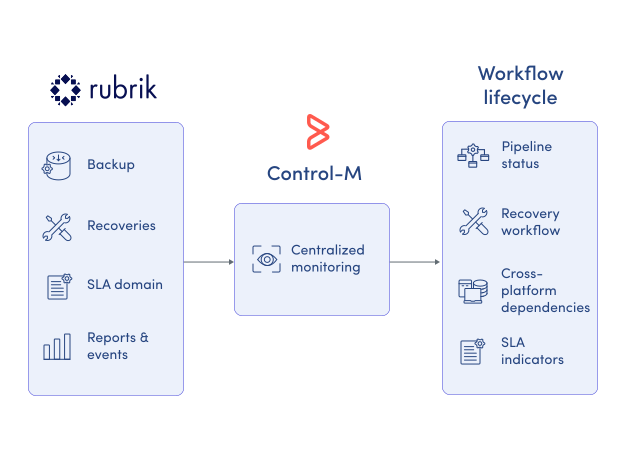
MONITOR RECOVERY
Monitor Rubrik operations and dependencies in one place.
Rubrik provides visibility into backup and recovery execution, but operational teams need visibility into the systems surrounding those processes. Control-M provides centralized monitoring across the entire workflow lifecycle:
-
Pipeline execution status
-
Recovery workflow history
-
Cross-platform dependencies
-
SLA risk indicators
-
Centralized operational dashboards
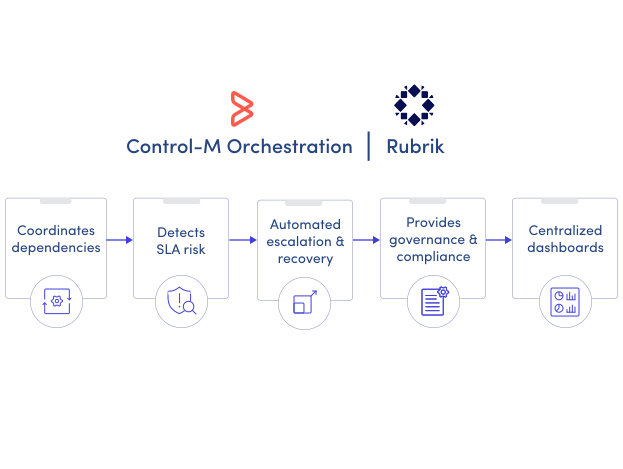
SLA ASSURANCE
Keep recovery objectives on schedule.
Recovery success depends on meeting backup windows and recovery commitments across multiple systems. Control-M continuously tracks workflow progress, predicts SLA violations, and automates escalation before service commitments are missed:
-
Recovery SLA tracking
-
Breach prediction alerts
-
Automated escalation paths
-
Priority-based notifications
-
Exception management workflows
Documentation
Bring order to complex workflows
Learn how Control-M helps teams orchestrate complex processes with greater visibility, coordination, and control.
