



TL;DR Summary: DevOps is a cultural shift that enhances collaboration between development and operations teams to improve software delivery efficiency through practices like continuous integration, delivery, and testing, leading to rapid, high-quality releases.
- DevOps breaks down silos between teams, promoting shared responsibilities.
- Adopting DevOps leads to improved communication, faster releases, and higher customer satisfaction.
DevOps is a trending topic that’s popular for increasing company productivity, no matter your industry. Every day more companies work to bring this disruptive model to their organizations.
DevOps has one primary goal to achieve: continuous integration to continuous delivery.
In doing so, the development and operations processes become faster and more resource friendly. Companies can save money while producing more high-quality software products for customer consumption or internal use.
In this introductory article, we’ll explain the basic concepts of DevOps, including how we got here, best practices, key topologies, and the most common benefits of a DevOps environment.
What is DevOps?
Traditionally in the IT industry, employees belonged to the development or ‘dev’ team. A separate team known as IT operations or ‘Ops’ worked to support IT.
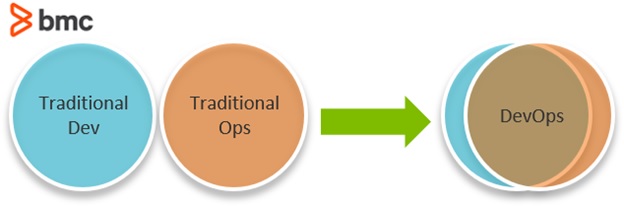
Dev and Ops teams had separate leadership, responsibilities, and objectives to achieve. In many companies, the teams worked on separate floors and rarely communicated. This ‘silos’ culture led to poor communication and collaboration among these teams—a rigid barrier between them that they’d bridge only when absolutely required.
The major organizational culture shift of DevOps successfully broke this silos mentality, bridging the gap between the Dev and Ops teams by making them:
- Work together
- Share responsibilities
- Take full ownership of the software they deliver throughout its software lifecycle
Nowadays, DevOps is widely embraced by the IT industry, including leading tech companies such as Amazon, Facebook, Google, Netflix, and BMC Software. More recently, companies are looking at how to spread the principles of DevOps across the entire organization, beyond IT.
Continuous Integration
Continuous Delivery
How DevOps developed
Before the year 2000, most IT industries adopted the classical waterfall model, a linear approach for software development.
- Developers had to spend a lot of time developing and integrating heavy pieces of code.
- QA engineers and operations teams, who worked in silos, spent more time testing the code.
The result? A large, sometimes years-long gap between software releases, with frequent bug fixes and software patches deployed between each release.
With the establishment of the Agile software methodology, IT industries moved on to developing software iteratively and frequently released them into production. Continuous Integration (CI) and Continuous Delivery (CD) are among the major techniques adapted in this model for the rapid delivery of software. (We’ll look at these concepts shortly.)
DevOps consequently promoted the smooth collaboration between development and operations teams at each step of the cycle. So, we can safely say that DevOps has its roots in the Agile methodology.
(Learn more about the history of DevOps.)

DevOps culture
When transitioning to a DevOps culture, organizations must change two important components:
- Their traditional methods of operating
- Their mindset
Generally, in a DevOps culture, both Dev and Ops teams work collaboratively through frequent communication.
In some organizations, DevOps engineers may do both development and operations work. They do not limit their responsibilities to the defined scope in their job role. Rather, they always share the responsibilities with other teams, considering the entire development lifecycle as a part of their responsibilities.
These engineers aim to increase the productivity and the quality of service to deliver the maximum value to their customers.
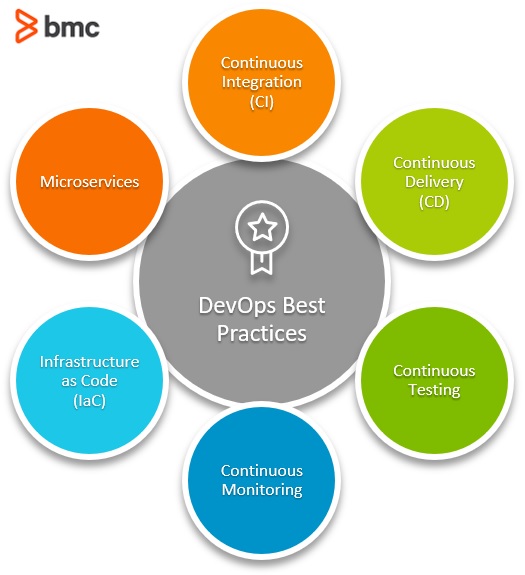
Of course, DevOps isn’t only about communication and collaboration. DevOps best practices are aimed to help you release software frequently and with the best quality. Prioritizing high efficiency, DevOps encourages the widespread use of tools to automate manual tasks.
Let’s take a look at common practices and related tools of any DevOps culture.
Traditionally, developers manually updated their code and then manually tested it.
Continuous Integration (CI) is a DevOps practice in which developers frequently merge their code changes to the central repository. Then, the code is built automatically and automated tests are run against the built code.
The main objective of this is to quickly identify bugs to improve the quality of the software.
In Continuous Delivery (CD), merged code changes are automatically built and deployed to a testing environment. Then, automated tests are executed against the deployed code to identify any bugs and allow the developers to fix them in advance.
Typically, the code is deployed to different testing environments progressively, where the code achieves a higher level of quality through a standard automated testing procedure before deploying to the production. Continuous Delivery ensures that the team always has a development-ready code.
CI/CD tools such as Jenkins, Bamboo, Travis, TeamCity, and many others help automates these tasks.
(Explore CI/CD and whether continuous deployment fits.)
Continuous Testing
The Continuous Testing practice helps to identify potential risks as early as possible in all stages of the development lifecycle to minimize the impact on end-users.
For instance, when the code is deployed to build servers, automated unit tests will run to identify any bugs in the code. If the unit tests are failed, the build will be rejected and the feedback is sent to the developer to revise the code. Thus, the code will be deployed to the QA environment for functional testing only if the build passes the unit tests.
Selenium, Travis, and Appium are some popular continuous testing tools in the IT industry.
Continuous Monitoring
The application, infrastructure, middleware, and networks will be monitored continuously for their performance, any defects, or security and compliance. To identify issues, most companies monitor metrics such as:
- CPU and memory usage
- Disk space
- Customer activities
- Security policies
By putting continuous monitoring into practice, you’ll always be alerted about any issues in environments from testing to production, helping you ensure high availability.
Popular Continuous Monitoring tools include Nagios, Sensu, Prometheus, and many more.
Infrastructure as Code
Infrastructure as Code (IaC) is a practice where infrastructure—virtual machines, load balancers, networks, etc.—are configured and managed using code rather than manually setting up and managing those resources. This has become an essential DevOps practice in organizations who specifically have moved to cloud platforms.
For example, Amazon Web services (AWS) provides APIs to programmatically interact with their cloud infrastructure. The use of code to define configuration helps to standardize the process allowing them to quickly deploy resources to the cloud.
Microservices
Unlike in traditional monolithic architectures, in microservices architecture, a single application is built as a set of small services or components. These separate services have their own functionality and their communication happens through a lightweight interface or an API.
As a widely adapted architecture in DevOps culture, microservices:
- Promote independent resource management within different components.
- Enhance the system availability by preventing a single point of failure, as there is no impact to other components when one component is crashed.
- Allow DevOps teams to add additional components with different functionalities without impacting other components.
(Understand microservice best practices.)
DevOps Topologies
The way DevOps are practiced highly depends on the Organization. According to Matthew Skelton and Manual Pais, Organizations adopt different types of topologies or team structures for DevOps to flourish. They define 9 types of topologies as follows.

DevOps practices
Dev & Ops collaboration
This is the ideal DevOps team structure where Dev and Ops teams smoothly collaborate. For example:
- Developers take seriously the tasks from the operations teams, receiving their input when required.
- Operations teams get a good understanding of the tasks that dev teams perform routinely.
Fully-shared Ops responsibilities
Implemented at Facebook and Netflix, this topology consists of Dev teams with Operations teams integrated into them. You will see only a small separation between Devs and Ops.
This is most suitable for companies that have single web-based applications.
Ops as infrastructure-as-a-service
This topology is suitable for organizations with different/multiple services which are hosted in the cloud platforms, but still have a traditional IT Operations department that is unlikely to change. Their Ops team is similar to infrastructure as a service (IaaS).
DevOps as external service
Some organizations may not have the expertise or can’t afford to have a separate ops team. Here, the dev teams can get support from a service provider who can manage the responsibilities of the software’s operational aspects.
DevOps teams with an expiry date
This structure functions as a temporary team that works towards bringing Dev and Ops teams together. That temporary team will become obsolete after achieving the pre-defined goal.
DevOps advocacy team
This topology is most suitable for teams that tend to drift apart. The advocacy team facilitates the dev and ops groups, keeping them engaged and continually making them aware of DevOps practices.
SRE team
Adapted in Google, this topology consists of a Site Reliability Engineering (SRE) Team. Devs need to provide evidence that their software is up to standards—and the SRE team can reject it if proven otherwise.
(Compare SRE & Ops teams.)
Container-driven collaboration
Containerization is the practice of encapsulating an application deployment and run-time requirements into a container. This removes some collaboration dependencies between Dev and Ops teams.
This structure is suitable for an organization that has a robust engineering culture.
(Learn more about managing code and containers.)
Dev & DBA collaboration
Some organizations that have multiple applications connected with large central databases have experimented with this topology. The structure is that database (DBA) specialization roles in both DBA and Dev teams are integrated, helping to bridge the gap between both parties.
Key benefits of DevOps
Organizations that embrace the DevOps culture see improvement in a lot of aspects of their software delivery process, including:
- Improving communication and collaboration between teams
- Enhancing organization efficiency and productivity
- Increasing the velocity of software releases
- Maximizing customer satisfaction (your customers now receive high-quality software)
- Ensuring system availability and reliability thanks to faster and earlier threat and incident detection
- Promoting innovation, thanks to sharing different ideas between teams
In this video, David Rizzo, VP Product Engineering at BMC Software, and David Kennedy, Solutions Architect, share how Compuware evolved to DevOps to increase innovation, reduce escaped defects, and improve MTTR.

DevOps is beyond a business model
Due to its abstract nature, it’s difficult to define DevOps in just a couple sentences. As I said earlier, DevOps is not just a business model but a cultural shift to integrate and automate software development and operations processes into a single unified workflow, focusing on the rapid release of high-quality software that satisfies the customer requirements.
DevOps achieves its excellence by integrating defined best practices into each step of the software development life cycle. Organizations are required to identify the team topology that best suit them in DevOps to strive for in the long term.
When embraced correctly, DevOps culture can bring enormous benefits for organizations for successful software releases.
Related reading
DevOps Guide
- What Is DevOps? A Comprehensive Introduction
- A Brief History of DevOps
- Introduction to DevOps Architecture
- Automation in DevOps: Why and how to automate DevOps practices
- What Is CI/CD? Continuous Integration & Continuous Delivery Explained
- How to Build a CI/CD Pipeline Using Jenkins
- DevOps Metrics for Optimizing CI/CD Pipelines
- Continuous Delivery Metrics
- Is Continuous Integration to Continuous Deployment a Progression - or Not?
- Differences Between Continuous Integration (CI), Delivery (CD), and Deployment
- Source and Version Control in DevOps
- What is Continuous Testing?
- Test Automation Frameworks: The Ultimate Guide
- Release Management in DevOps
- Explained: Monitoring & Telemetry in DevOps
- Application Performance Management in DevOps
- DevOps Orchestration in the SDLC
- Introduction To Database DevOps
- The Role of Microservices in DevOps
- The Role of Virtualization in DevOps
- Containers & DevOps: How Containers Fit in DevOps Delivery Pipelines
- What Is a Container Pipeline?
- What is a DevOps Toolchain?
- Managing Containers and Code for DevOps
- The Role of Agile in DevOps
- The Role of Cloud in DevOps
- What is FinDevOps?
- Top DevOps Trends in 2022
- DevOps Values & Principles
- DevOps Metrics and KPIs
- DevOps Advice for Small, Medium, & Large Organizations
- DevOps Team Structure
- Top DevOps Books to Read Today
- Book Review of The Phoenix Project: DevOps For Everyone
- DevOps Influencers: 11 DevOps Experts to Follow on Twitter
- GitHub, GitLab, Bitbucket & Azure DevOps: What’s The Difference?
- Best Practices: How To Architect Applications for Kubernetes
- Configuration Management in DevOps
- DevOps Branching Strategies Explained
- DevOps Job Titles, Roles, & Responsibilities
- Testing in DevOps: Concepts, Best Practices & More
- The Complete DevOps Certifications Guide for 2022
- What Is The Kubernetes Operator Pattern?
These postings are my own and do not necessarily represent BMC's position, strategies, or opinion.