




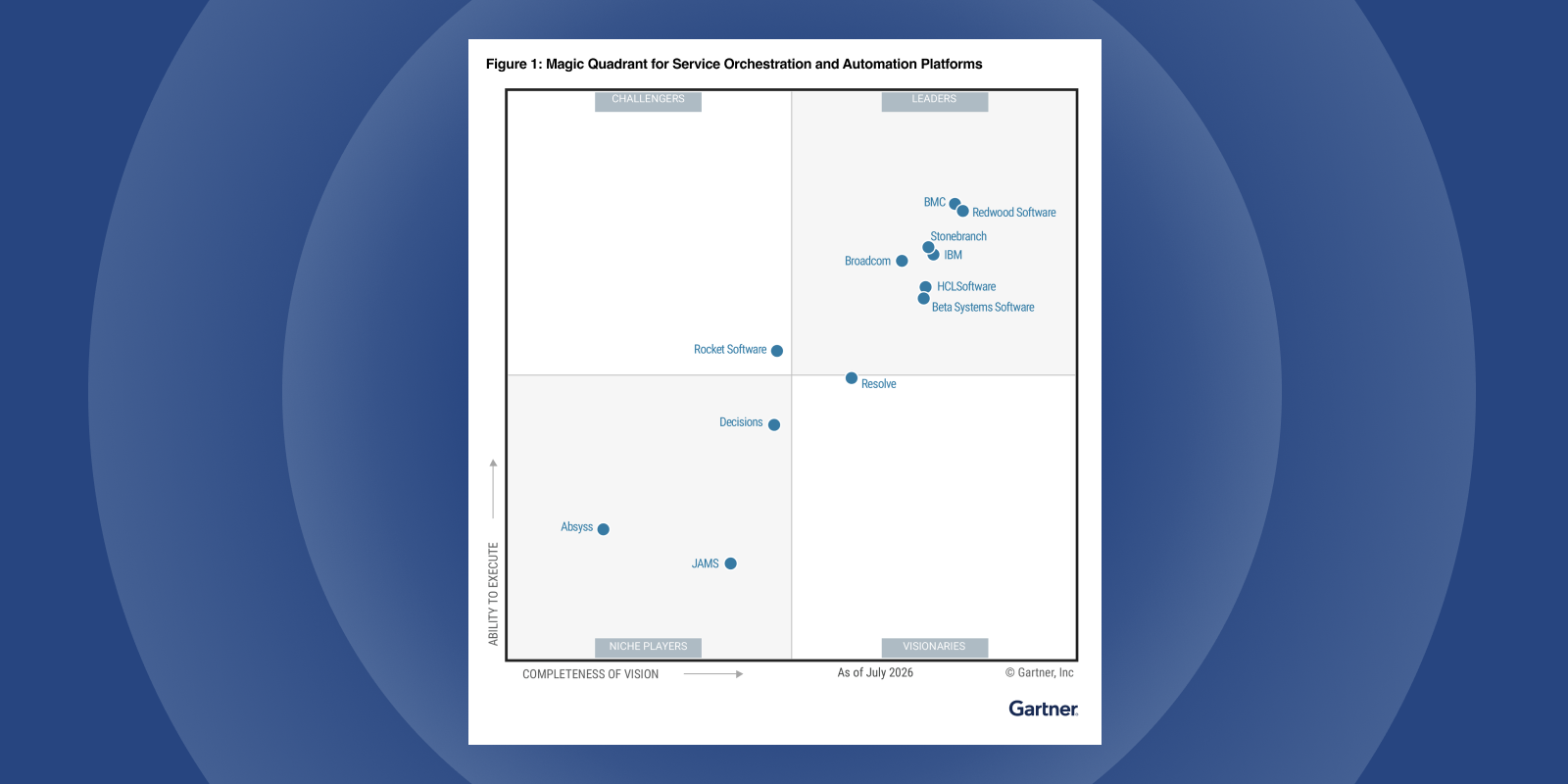
TL;DR Summary: Workflow orchestration improves operational efficiency by centralizing job scheduling across diverse environments. Control-M consolidates multiple schedulers into a single interface, enhancing visibility and proactive management of SLAs.
- Control-M automates job execution, reducing manual intervention.
- It provides centralized monitoring for workflows across various platforms.
Real users weigh in on the value of Control-M
Application workflow orchestration gives IT teams a centralized, automated way to coordinate complex job schedules across platforms, clouds, and environments. Control-M is one of the most widely adopted tools for this purpose—helping organizations consolidate fragmented schedulers, meet SLAs proactively, and scale data and application workflows without adding manual overhead. Here are examples from PeerSpot members who use Control-M to do exactly that.
IT departments are using application workflow orchestration tools like Control-M to achieve operational excellence and drive digital transformation initiatives forward. PeerSpot members who use Control-M report that they've been able to solve critical business challenges while leveraging new best practices and technologies around DevOps, data, and the cloud to spur innovation. Here are just a few examples:
How does workflow orchestration simplify complex scheduling?
Consolidating scheduling across platforms is one of the most immediate benefits of workflow orchestration. Don W., an Operations Manager at a large retailer, explained: "We had multiple scheduling solutions across several platforms. Going to Control-M consolidated all of them and allowed us reactivity… based on the completion of processing." A Team Lead at a transportation company with over 5,000 employees shared a similar view: "We value Control-M mainly for the ability to control multiple nodes in a coordinated manner."
Service Level Agreements (SLAs) are a critical part of the application workflow orchestration picture. IT teams are obligated to keep workflows running at an agreed-upon rate of performance, with contractual mandates for uptime and job execution. Jim P., E-Business Engineer at a financial services firm, described Control-M's impact: "Control-M has improved application reliability and the SLAs in our company by quite a bit. You can see if problems are coming. If we have an SLA in a couple of hours, we know well before that couple hours if processing is behind, and it allows us to take some preventative action."
A Digital Solutions Manager at a transportation company with over 10,000 employees added: "It's a tool which allows us to do scheduled work. It allows for notifications when jobs aren't running within that scheduled time frame. This improves the opportunity to meet SLAs." For Don W., SLA visibility came from Control-M's Batch Impact Manager, which "proactively warns when processing is behind and SLAs are in jeopardy of being missed."
Auditability is another dimension where workflow orchestration delivers measurable value—particularly in regulated industries. The Manager of Digital Solutions at the transportation company observed: "It creates an audit trail for jobs that we run off of it. The opportunity to automate work so you have an audit trail, especially with governmental requirements in a regulated industry, such as the airline industry—it's really important that we have that audit trail."
How does Control-M scale workflow orchestration across production environments?
Control-M delivers workflow orchestration at scale across software development, databases, and production applications. A Senior Operations Analyst at an insurance company noted that Control-M "has definitely helped development. Now we have multiple developers running their jobs and it gives them a lot of flexibility." A Control-M Tech Lead at a financial services firm highlighted that "the most valuable feature is the Autoedit variable resolution in planning. This feature allows developers to better understand the schedule and allows them to correct any potential issues in advance."
Paul W., VP Control-M Scheduling at a financial services firm, described the consolidation benefit in practical terms: "Instead of 800 applications internally doing their own thing, we centralize it into one location where there are notifications. Taking the power of economies of scale into one point of focus, it saves us money for sure. We turned a company of mom-and-pop little fiefdoms all over the place into a company where things are centralized in one location." A System Admin and Architect at a financial services firm added simply: "I would recommend it for the scalability and dependability."
How does Control-M orchestrate data and analytics workflows at scale?
Data volume growth and business acquisitions test the limits of any workflow orchestration platform. Paul W. described his experience: "We've added a lot of big-data processing and a lot of other processing and handled it quite well. We really haven't had any serious outages in quite a long time, even through the large growth we've had. We've doubled the work and it's handled it seamlessly." A Database Security Specialist at a large manufacturing company confirmed: "Control-M has been there on back of all automated work lists by providing consistency, timely execution, and removing chances of human errors."
A Production Engineer at a small tech services company described a complex data orchestration use case: "We have many feeds coming in from different companies which are used by the business for various reasons and we must collectively have a central point to gather the files and feeds. We also use Control-M for encryption, decryption, and sending data across to different business users that begin at a point of time and making sure that we are not missing unnecessarily. We have a lot of business which depends on feeds which, if not properly processed, affect the stock exchange. Control-M acts as a mediator in between that and provides it in a very efficient way." He added that "this has reduced a lot of manual intervention required as a business."
To learn more about what PeerSpot members have to say about Control-M, click here.
Frequently asked questions about workflow orchestration with Control-M
What is application workflow orchestration?
Application workflow orchestration is the automated coordination of dependent job sequences across applications, systems, and environments. It ensures processes execute in the correct order, on schedule, and with full visibility—reducing manual intervention and the risk of SLA breaches.
How does workflow orchestration help IT teams meet SLAs?
Tools like Control-M monitor batch workloads in real time and alert teams when processing falls behind before a deadline is missed. This allows IT teams to take corrective action proactively rather than responding to failures after the fact.
What types of organizations benefit most from workflow orchestration?
Financial services, transportation, retail, insurance, and manufacturing organizations are among those that benefit most—particularly where regulatory compliance, audit trail requirements, and high-volume data processing are critical operational needs.
Can Control-M consolidate scheduling across multiple platforms and clouds?
Yes. Control-M is designed to replace fragmented, application-specific schedulers with a single workflow orchestration layer spanning multiple platforms, clouds, and environments—giving teams centralized control, monitoring, and notifications in one location.
What is Control-M's Batch Impact Manager?
Control-M's Batch Impact Manager is a feature that proactively monitors batch workloads and alerts teams when jobs are running behind schedule and SLAs are at risk, enabling preventative action before deadlines are missed.
The views and opinions expressed in this post are those of the author and do not necessarily reflect the official position of BMC.
These postings are my own and do not necessarily represent BMC's position, strategies, or opinion.