




TL;DR Summary: The future of agentic AI innovation hinges on trusted execution rather than mere intelligence. This concept emphasizes the necessity for AI agents to operate reliably within established enterprise workflows, ensuring accountability and governance. As organizations advance in AI capabilities, they must focus on how agents can execute tasks effectively while adhering to operational standards.
Trusted execution is essential for reliable and accountable AI operations.
Gartner recognized BMC for its strengths in operationalizing agentic AI.
Let an agent generate an answer? Easy.
Let it participate in a business process where governance, approvals, dependencies, controls, and accountability are non-negotiable. Harder.
That’s why the next phase of agentic AI innovation may have as much to do with trusted execution as intelligence.
An agent connected to Jira, GitHub, ServiceNow, and a cloud platform can open tickets, read repositories, trigger APIs, and update records. That doesn't necessarily mean it can reliably execute a release, provision an environment, onboard a customer, or resolve an incident within enterprise controls. That only demonstrates access.
What's often missing is the operational knowledge required to move work from initiation to completion. Enterprise workflows already contain that knowledge in the form of approvals, dependency logic, exception handling, governance, and auditability,all of which are essential for reliable and accountable execution.
Trusted execution is the ability for agents to inherit those capabilities and apply them consistently when executing work.
Four Questions That Reveal Whether an Agent Can Execute Trusted Work
If trusted execution is the next opportunity for agentic AI, how do you determine whether an agent is prepared for it? Focus not only on model quality, but also on how the agent operates inside production environments.
These four questions can help separate experimental agents from production-ready ones:
- Can the agent participate in real business operations?
Can it discover and execute approved workflows and automation assets, or is it limited to isolated actions and API calls? - What happens when the plan doesn't survive reality?
Can execution recover automatically, escalate appropriately, or stop safely when intervention is required? - Who decides what the agent is allowed to do?
What controls, approvals, policies, and governance requirements constrain its actions? - Could you defend its actions to an auditor?
Can you understand what happened, why it happened, and which systems, workflows, and approvals were involved?
If these questions are difficult to answer confidently, you may have a gap between what the agent can do and what your organization can trust it to do.
Why the Next Phase of Agentic Innovation is Trusted Execution
As agent reasoning, autonomy, and model quality advance, the differentiator is shifting from whether agents can reason about work to whether they can execute work reliably in production environments.
Consider three scenarios where reasoning alone provides limited value, and the real business outcome depends on trusted execution.
- An incident response agent identifies a capacity issue and recommends scaling resources. That's useful.
→ What's more useful? The same agent coordinates a response across teams and systems, initiating remediation steps, escalating when thresholds are met, notifying stakeholders, and ensuring the response progresses according to established procedures.
- A software delivery agent determines a release is ready for production. Useful.
→ More useful? The agent executes the approved deployment workflow, validates prerequisites, verifies upstream and downstream dependencies, enforces change controls, and automatically rolls back if validation fails.
- A cloud operations agent receives a request for a new environment. Useful.
→ More useful? The agent executes an approved provisioning process that enforces governance requirements, applies configuration standards, validates compliance policies, obtains required approvals, and creates a complete audit trail of the request.
In each case, the breakthrough isn't better reasoning. It's the ability to translate intelligence into action through operational workflows that already contain the coordination, safeguards, and governance required for production execution.
Quick Take:
The more agents take on real work, the more trusted execution becomes a catalyst for innovation, not just a way to keep things in check.
What Gartner® Recognized
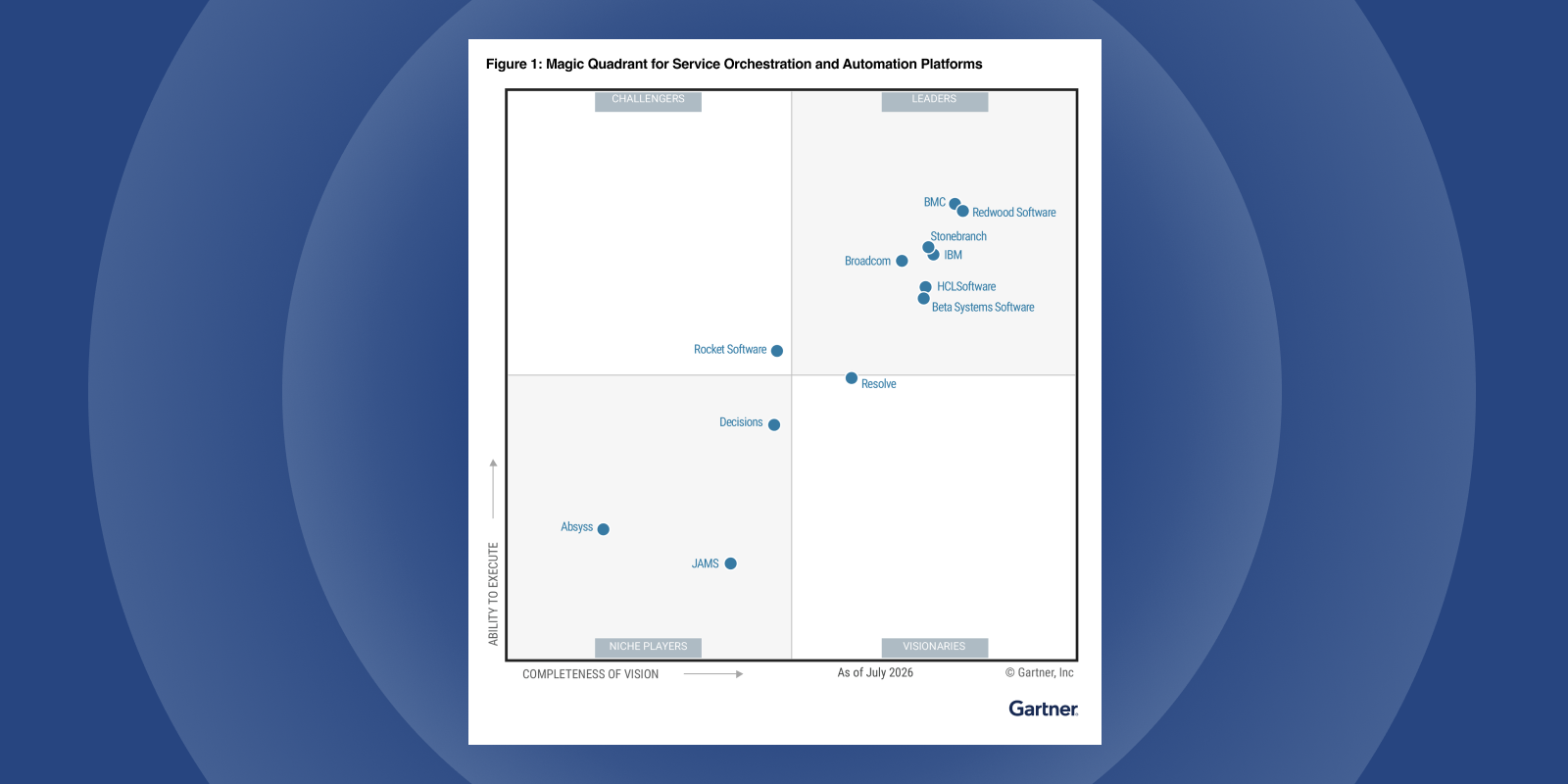
Gartner highlighted BMC’s vision and execution in the 2026 Gartner® Magic Quadrant™ for Service Orchestration and Automation Platforms.
What's notable about that mention is operationalizing agents. BMC Control-M's emphasis isn't simply on what agents can discover or reason about. It's about enabling agents to execute enterprise automation within defined governance constraints.
For AI teams moving agents from experimentation into production, that's a consequential difference because value isn't created when an agent generates a recommendation. It's created when we can trust them to execute.
That's why trusted execution may become one of the defining challenges and opportunities of the next phase of agentic AI.
For a broader perspective on where orchestration platforms are heading, explore the Gartner® Magic Quadrant™ and see why Gartner recognized BMC as a Leader in Ability to Execute.
Gartner, Magic Quadrant for Service Orchestration and Automation Platforms, Hassan Ennaciri, Daniel Betts, Chris Saunderson, 5 August 2026
Gartner and Magic Quadrant are trademarks of Gartner, Inc. and/or its affiliates.
Gartner does not endorse any company, vendor, product or service depicted in its publications, and does not advise technology users to select only those vendors with the highest ratings or other designation. Gartner publications consist of the opinions of Gartner’s business and technology insights organization and should not be construed as statements of fact. Gartner disclaims all warranties, expressed or implied, with respect to this publication, including any warranties of merchantability or fitness for a particular purpose.
These postings are my own and do not necessarily represent BMC's position, strategies, or opinion.