Let us know how we can help
Sales & Pricing
Speak to a rep about your business needs

Help & Support
See our product support options
General inquiries and locations
Contact us


Orchestrate Hybrid and Multi-Cloud Data Workflows—End to End
Coordinate Snowflake, Databricks, Airflow, Azure Data Factory, and more through a single orchestration layer across hybrid and multi‑cloud environments.
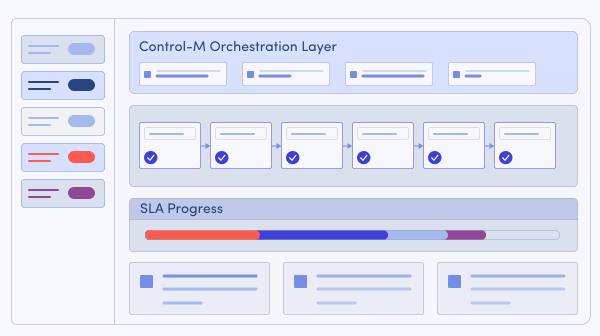
Control‑M operates above platform‑specific schedulers to coordinate dependencies, visibility, and SLA tracking across workflows that span on‑prem and cloud environments.
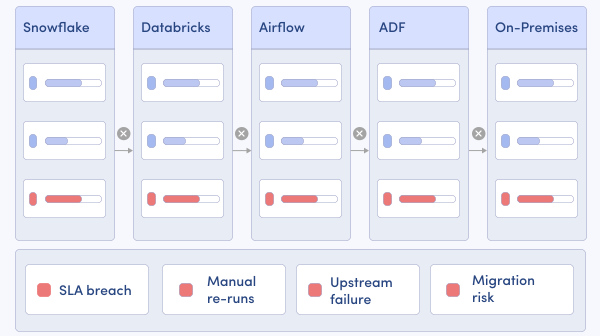
Why Cross‑Platform Data Workflows Are Hard to Orchestrate
Teams run analytics, ingestion, and transforms across Snowflake, Databricks, Airflow, Azure Data Factory, and on‑prem systems.
Each platform can schedule its own jobs, which works until a workflow crosses platforms.
-
Schedulers and DAGs have no idea what’s happening upstream or downstream
-
Handoffs get hard‑coded, manually triggered, or handled “out of band” (outside the tools themselves)
-
Visibility stops at the edge of each tool
-
When something fails, it’s hard to see the blast radius
-
Hitting SLAs becomes guesswork as pipelines and teams multiply
Takeaway: The more platforms you add, the more coordination work lands on people instead of systems.

What’s Required When Workflows Span Hybrid and Multi‑Cloud
Teams want orchestration above existing platforms—not tool replacement.
An orchestration layer needs to:
-
Work across clouds and on-prem environments
-
Support event- and dependency-driven automation
-
Provide clear visibility across the entire workflow
-
Scale with enterprise security and governance requirements
Control‑M vs Platform‑Native Schedulers for Hybrid and Multi‑Cloud Data Workflows
When workflows span platforms and environments, scheduling alone isn’t enough.
| Key Requirement | Platform‑Native Orchestrators (Airflow, ADF, Cloud Schedulers) | Control‑M Enterprise Orchestration |
|---|---|---|
| Hybrid Orchestration (Cloud + On‑Prem) | Not designed for end‑to‑end hybrid coordination | Built to orchestrate cloud and on‑prem workflows together |
| Multi‑Cloud Coordination | Separate schedulers per platform or cloud | Single orchestration layer across multiple clouds |
| Cross‑Platform Dependencies | Manual handoffs, APIs, or custom logic | Native dependency management across tools and environments |
| Event‑Driven Automation Across Systems | Events typically limited to the local platform | Event‑driven orchestration across platforms, data, APIs, and jobs |
| End‑to‑End Visibility & SLAs | Tool‑level monitoring only | Unified visibility with predictive SLA management |
| Architectural Role | Schedules work within a platform | Orchestrates workflows above platforms without replacing them |
What this comparison means in practice
Platform‑native schedulers like Airflow or Azure Data Factory are good at running workflows inside their own environments.
Control‑M doesn’t replace these tools. It orchestrates above them, providing a centralized control plane to manage dependencies, visibility, and service levels across the entire workflow—without changing how work executes in the platforms teams already trust.
How Control‑M Supports Hybrid & Multi‑Cloud Orchestration at Scale
Event driven coordination across systems
Control-M triggers workflows based on events—data arrival, job completion, files, or application signals—not just schedules. It coordinates batch, micro‑batch, and streaming steps across platforms, automatically triggering downstream work wherever it runs.
View demo
End to end visibility and SLA control
Control-M provides a single view of workflows that span multiple tools—not just individual jobs or DAGs. Teams can track and forecast SLAs across system boundaries, understand downstream impact, and initiate automated recovery when issues occur.
Enterprise control at hybrid and multi cloud scale
Control‑M supports role‑based access, Dev/Test/Prod separation, and auditability for regulated environments. It scales from hundreds to tens of thousands of workflows, keeping execution distributed while orchestration stays centralized.
View datasheet
Hybrid & Multi‑Cloud Data Orchestration in Practice
How Air Europa orchestrates hybrid and multi‑cloud data workflows
-
THE SCALE: ENABLING A DECENTRALIZED DATA MESH ORGANIZATION
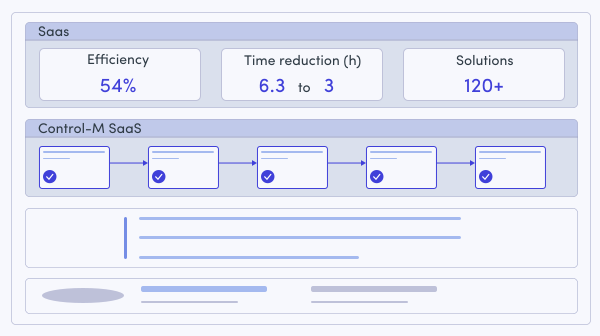
120+ BI and data solutions across cloud and on‑prem platforms
-
The constraint: Data pipelines spanning platforms and environments
Air Europa ran data pipelines across cloud and on prem platforms, spanning batch, real time, analytics, and BI workloads. Platform specific schedulers made it difficult to manage dependencies, maintain visibility, and meet SLAs at scale.
-
The approach: Implement orchestration above existing data platforms
Rather than replacing existing tools, Air Europa implemented Control-M SaaS as orchestration above existing platforms. Control-M coordinated dependencies across cloud services, data platforms such as Snowflake, and on prem systems, while execution remained distributed across the underlying platforms.
-
The Outcome: Gained measurable efficiency and SLA improvements
Using Control‑M as a centralized orchestration layer, Air Europa reported a 54% increase in DataOps workflow efficiency. In one highly sequenced workflow, parallel execution reduced processing time from 6.5 hours to 3 hours. Air Europa also reported improved service level agreements for analytical applications, with data available when needed.

José Carlos Bermejo Rubio,
Director of Data & Analytics, Air Europa
When Control-M Is the Right Choice
Control‑M is a fit when you:
- Run data workflows across multiple clouds or hybrid environments
- Need orchestration above Airflow, ADF, or cloud schedulers
- Depend on business‑critical pipelines with strict SLAs
- Want centralized control without redesigning their data stack
When Control‑M may not be the right fit
Control‑M may be unnecessary if all workflows run within a single platform or cloud, have minimal cross‑system dependencies, and don’t require centralized SLA tracking or hybrid operational visibility.
Next Step—Evaluate Hybrid and Multi‑Cloud Data Workflows as One System
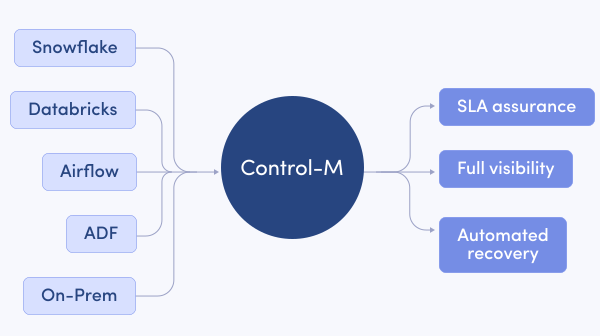
Explore Control-M Data Workflow Use Cases
See how Control‑M coordinates dependencies, visibility, and SLAs across platforms—without replacing the tools you already use.
