Let us know how we can help
Sales & Pricing
Speak to a rep about your business needs

Help & Support
See our product support options
General inquiries and locations
Contact us


 Control-M + IBM MQ
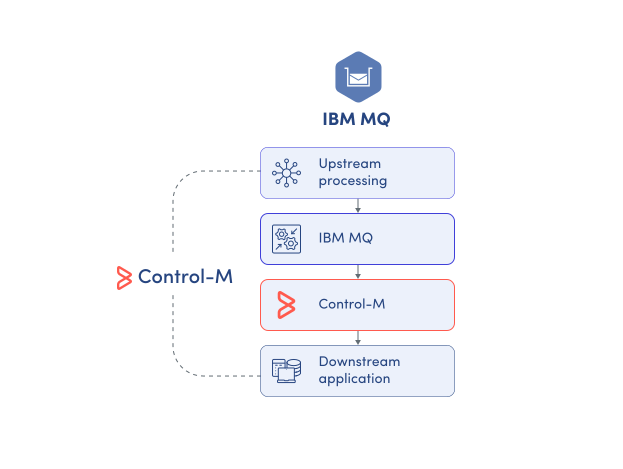
Your IBM MQ workflow starts before a message-send job ever executes — and it can fail when something upstream breaks. An IBM Db2 settlement extract that arrives incomplete. An IBM DataStage transformation that finishes after the nightly cutoff. Control-M orchestrates the full chain: Db2 data extraction, DataStage transformation, IBM MQ message execution, and downstream settlement reconciliation.
common workflow issues
Does this sound like your week?
These aren’t edge cases. They’re the normal operating conditions for teams running IBM MQ across multiple tools. Here’s how Control‑M handles each one.
UPSTREAM DEPENDENCY
Your Db2 extract failed. The IBM MQ settlement message is still scheduled.
Control-M evaluates upstream job completion before releasing the IBM MQ message job. If the Db2 extract or DataStage transformation fails, dependency conditions prevent premature execution and keep incomplete settlement data from reaching downstream applications.
REPLY TIMEOUT
Control-M waits for a correlated IBM MQ reply (matched by Correlation ID) and evaluates the result against configured job conditions.
Control-M can wait for a correlated IBM MQ reply and evaluate the result against configured job conditions. When the expected response does not arrive successfully, operators can receive failure notifications while downstream reconciliation remains gated.
CONNECTION RECOVERY
The IBM MQ connection dropped mid-run during overnight processing.
Control-M applies configured retry behavior for supported IBM MQ job failures, including transient connection errors. Retry attempts and intervals provide controlled recovery, while unsuccessful execution remains visible in monitoring and prevents dependent jobs from proceeding.
SLA RISK
It's 05:45. An IBM MQ acknowledgement threatens the 06:00 reporting deadline.
Control-M associates IBM MQ jobs with business SLA services and tracks dependencies across the complete workflow. Predictive SLA monitoring helps operations teams identify deadline risk, investigate delayed jobs, and prioritize recovery before reporting commitments are missed.
CROSS-PLATFORM VISIBILITY
The IBM MQ message completed. Your SAP reconciliation job remains blocked.
Control-M displays IBM MQ execution status alongside dependent SAP and database jobs in one monitoring environment. Operators can inspect job results, trace unmet dependencies, and identify where processing stopped without manually correlating separate scheduling consoles.
Control‑M + IBM MQ
Control‑M + IBM MQ
|
Platform & OS coverage |
Linux Control-M Agent · Windows Control-M Agent · IBM MQ endpoints · Control-M self-hosted · Control-M SaaS |
|
Job types supported |
IBM MQ message send · wait for reply · correlated reply processing · event-driven trigger on message arrival · cross-platform batch dependencies |
|
SLA monitoring & alerting |
SLA service association · deadline monitoring · SLA breach prediction · job failure notifications · escalation rules · dependency monitoring |
|
Audit trail & access controls |
job execution history · job output inspection · role-based Control-M authorization · centralized connection profiles · credential management · Automation API job definitions |
end-to-end orchestration
One production workflow. Every tool in the stack.
Control‑M orchestrates workflows across IBM MQ, IBM Db2, IBM DataStage, SAP, file transfers, and cloud services in a single job flow — with dependency tracking, SLA visibility, and automated recovery across all of them.
- Cross-tool dependency: Db2 extract → DataStage transformation → IBM MQ request/reply → SAP reconciliation
- Data-aware triggers: file arrival, API event, upstream job completion, correlated IBM MQ reply
|
IBM MQ |
message submission · reply waiting · job status monitoring · SLA association |
|
IBM Db2 |
database extraction · completion tracking · upstream dependency management |
|
IBM DataStage |
transformation execution · ETL dependency coordination · job monitoring |
|
SAP |
business job scheduling · reconciliation dependencies · completion tracking |
|
Control-M Managed File Transfer |
file arrival detection · secure file delivery · transfer completion dependencies |
|
Cloud services |
API-driven execution · cloud job orchestration · cross-environment dependency management |
MONITOR WORKFLOWS
Monitor IBM MQ execution across your enterprise workflows
IBM MQ moves messages reliably between applications, but operators still need to understand the jobs surrounding each message handoff.
-
IBM MQ job execution status
-
Job results and output inspection
-
Upstream and downstream dependency visibility
-
Cross-platform workflow monitoring
-
Centralized job failure notifications
SLA ASSURANCE
Keep IBM MQ workflows aligned with business deadlines
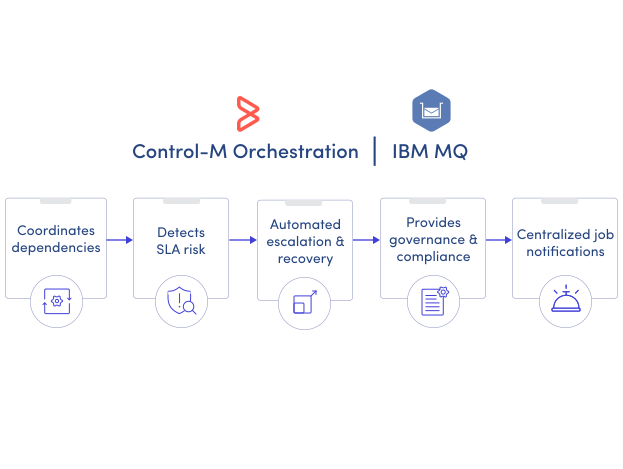
IBM MQ manages message exchange, not the business deadlines spanning extraction, transformation, messaging, and reconciliation. Control-M tracks IBM MQ jobs within end-to-end SLA services, helping enterprise operations teams anticipate delays and coordinate timely recovery through:
-
Business service deadline monitoring
-
Predictive SLA breach notifications
-
Cross-platform critical dependency visibility
-
IBM MQ job failure escalation
-
End-to-end service status tracking
Documentation
Bring order to complex workflows
Learn how Control-M helps teams orchestrate complex processes with greater visibility, coordination, and control.
