Let us know how we can help
Sales & Pricing
Speak to a rep about your business needs

Help & Support
See our product support options
General inquiries and locations
Contact us


 Control-M + Azure App Services WebJobs
Your Azure App Services WebJobs workflow starts before a triggered WebJob is ever invoked against its configured Web App host — and it can fail when something upstream breaks. An Azure Blob Storage container never receives its upstream input file before the triggered WebJob's blob trigger resolves its input binding. An Azure Logic Apps workflow overruns its HTTP action timeout before posting its processed payload to the triggered WebJob's Azure Queue Storage input queue. Control-M orchestrates the full chain: Azure Blob Storage ingestion, Azure Data Factory transformation, Azure App Services WebJobs execution, and Azure Service Bus delivery.
common workflow issues
Does this sound like your week?
These aren’t edge cases. They’re the normal operating conditions for teams running Azure WebJobs across multiple tools. Here’s how Control‑M handles each one.
UPSTREAM DEPENDENCIES
The WebJob is scheduled. The input file never arrived.
Control-M waits for verified file arrival events before execution begins. It validates prerequisites, prevents premature job starts, and automatically triggers the WebJob only when all required upstream conditions are satisfied.
FAILURE RECOVERY
A midnight WebJob failed. Nobody noticed until morning.
Control-M detects execution failures immediately, triggers configurable retries, routes alerts to operational teams, and prevents downstream processes from running on incomplete results, reducing recovery time and operational risk.
API ORCHESTRATION
The API dependency timed out. The workflow stalled.
Control-M orchestrates API calls, evaluates response status, applies retry policies, and resumes workflow execution when services recover. Teams gain controlled recovery without custom scripting or manual intervention.
RELEASE COORDINATION
Deployment finished late. The WebJob ran anyway.
Control-M coordinates deployment pipelines and runtime workflows through dependency-aware scheduling. WebJobs execute only after successful deployment validation, eliminating timing conflicts between application releases and operational processing.
SLA VISIBILITY
The batch completed. The business deadline didn’t.
Control-M tracks end-to-end workflow SLAs across WebJobs, cloud services, and dependent applications. Predictive alerts identify risks before deadlines are missed, giving teams time to act before business impact occurs.
Control‑M + Azure App Services WebJobs
Control‑M + Azure App Services WebJobs
|
API and automation capabilities |
Azure REST API · Azure CLI · Azure SDKs · webhook triggers · event-driven automation |
|
Deployment models & infrastructure flexibility |
Azure App Service · Windows WebJobs · Linux workloads · hybrid cloud workflows · Control-M SaaS · Control-M self-hosted |
|
Security posture |
Azure AD integration · RBAC · managed identities · encrypted-in-transit · encrypted-at-rest · audit logging · credential vault integration |
|
Incident response & MTTR enablement |
automated retry policies · failure detection · SLA breach alerting · blast-radius containment · ServiceNow integration · PagerDuty integration · runbook automation |
end-to-end orchestration
One production workflow. Every tool in the stack.
Control-M orchestrates workflows across Azure App Service WebJobs, Azure Functions, Azure Storage, Azure DevOps, Kubernetes, APIs, and cloud services in a single job flow—with dependency tracking, SLA visibility, and automated recovery across all of them.
- Cross-tool dependency: Azure DevOps deployment → Azure WebJob → Azure SQL Database → ServiceNow update
- Data-aware triggers: file arrival, API event, deployment completion, database status
|
Azure App Service WebJobs |
execution orchestration · dependency management · status |
|
Azure DevOps |
pipeline trigger · deployment validation · release coordination |
|
Azure Storage |
file arrival detection · event triggers · data validation |
|
Azure Functions |
workflow coordination · event chaining · status tracking |
|
Azure SQL Database |
query execution · dependency control · completion validation |
|
Kubernetes |
workload trigger · operational visibility · recovery automation |
|
ServiceNow |
incident creation · escalation workflow · audit tracking |
MONITOR EXECUTION
Monitor Azure WebJobs across the full workflow.
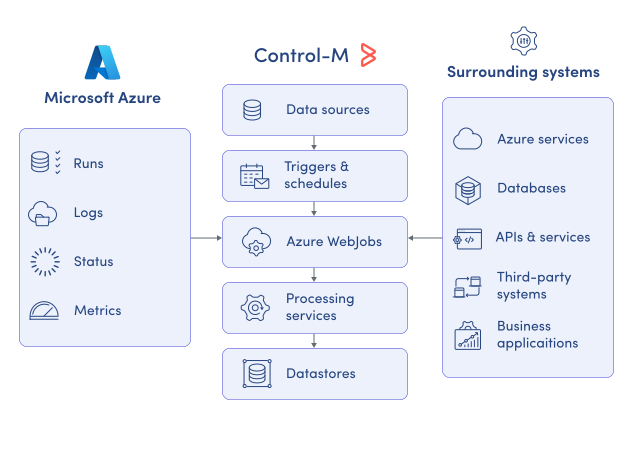
Azure provides visibility into individual WebJob execution, but operational teams need visibility across every dependency surrounding it. Control-M centralizes workflow monitoring, status tracking, and dependency context in a single operational view:
-
WebJob execution status
-
Runtime history tracking
-
Dependency visualization
-
Failure root-cause context
-
Operational alerting
SLA ASSURANCE
Prevent missed deadlines around Azure WebJobs.
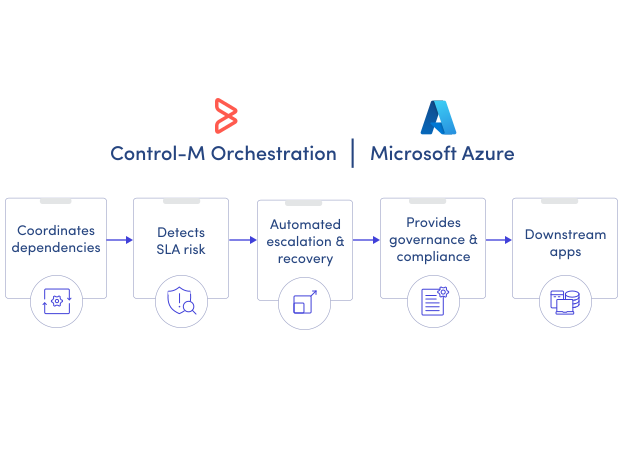
Native platform tooling can show execution outcomes but cannot manage business-wide workflow commitments. Control-M tracks service levels across every upstream and downstream dependency, helping teams prevent deadline failures before they happen:
-
SLA tracking
-
Breach prediction alerts
-
Automated escalation
-
Dependency-aware scheduling
-
Recovery automation
Documentation
Bring order to complex workflows
Learn how Control-M helps teams orchestrate complex processes with greater visibility, coordination, and control.
