Let us know how we can help
Sales & Pricing
Speak to a rep about your business needs

Help & Support
See our product support options
General inquiries and locations
Contact us


How does AI-augmented code modernization work?
AI-augmented code modernization combines specialized AI, generative AI, and deterministic analysis to understand, restructure, and selectively transform existing applications. BMC AMI DevX applies this approach to mainframe modernization through Analyze, Build, Convert. Analysis establishes which applications to modernize, how programs work and what they depend on, and what they must continue to do. Teams can then improve the architecture before selectively converting code, focusing modernization efforts where they deliver the most value while allowing other applications and components to remain in their existing language.
Which COBOL programs should you modernize?
AI can convert COBOL to Java, but not every program needs to be converted. The first step is identifying which applications and programs are worth the modernization effort.
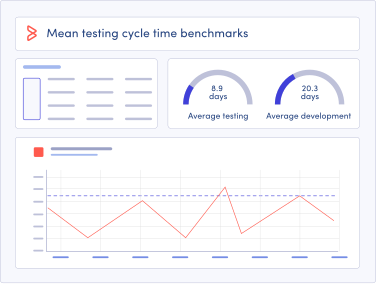
BMC AMI zAdviser Enterprise uses operational telemetry your teams already generate to help identify modernization candidates. Application Analysis correlates source-code assessment with production abend history and development activity to show application purpose and business logic, production stability and abend distribution, program-level risk, and where developer knowledge is concentrated.
The analysis also provides modernization guidance spanning short-term COBOL-to-COBOL refactoring and medium-term modernization, helping teams distinguish where modernization effort should be focused.
Role-Based Analysis extends the same application analysis for different roles, including development managers, architects, lead developers, new and existing developers, and QA engineers. Each role receives information relevant to its work, helping teams understand unfamiliar applications and transfer application knowledge.
What does this program do, and what does it touch?
Once modernization candidates are identified, the work moves to the program level. BMC AMI DevX Code Insights helps developers understand what a program does, how it is structured, what it connects to, how data moves through it, and what happens when it runs.
Explain unfamiliar code
BMC AMI Assistant provides natural-language summaries of business logic and logic flow across COBOL, PL/I, JCL, and Assembler directly in Eclipse or VS Code.
Map dependencies and impact
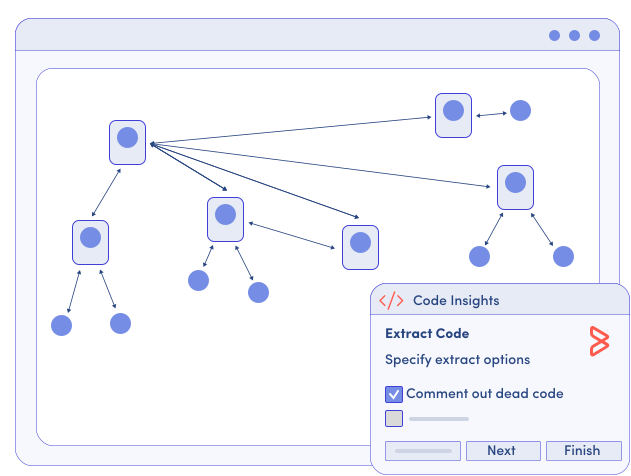
BMC AMI DevX Code Insights uses Impact Analysis to map connections to other programs, JCL, copybooks, datasets, Db2 tables, and IMS databases.. It builds from metadata, so developers can see what surrounds a program without running the application.
Visualize structure and trace data flow
Code Structure and Logic Charts show how the program is structured and how its logic flows. Data Flow Analysis traces individual fields from input to output through the procedures and conditional statements that affect them.
See what happens at runtime
Runtime Visualizer records the application as it runs and charts every program and I/O call in the sequence it occurred. Execution data shows which paths the workload takes, how often a call fires, and where I/O concentrates. The trace can be saved and replayed without a source code dependency.
What must this program keep doing?
Understanding how a program works today is not the same as knowing what it must accomplish after modernization.
BMC AMI DevX Code Insights uses Program Requirements to extract business rules from existing COBOL and write them as formal specifications in EARS format.
The specifications capture what the program must accomplish, not how it currently goes about it. A Java developer can read what the program must do without reading COBOL. An analyst can work from a specification instead of raw source.
The specification also becomes the test. Validating converted Java against line-by-line equivalence checks that the new code repeats the old code. Validating against a requirement checks that it does the job.
How the three levels of analysis work together
Portfolio intelligence identifies the modernization targets. Program intelligence shows how those programs work and behave. Specification intelligence captures what they must do. Together, these three levels establish what to modernize, how the application works, and what must be preserved before architecture or language changes begin. These AI-assisted capabilities also contribute to the broader agentic mainframe vision by making mainframe application knowledge more accessible and supporting informed modernization decisions.
Then build, then convert
Analysis establishes which applications to modernize, how programs work and behave, and what they must continue to do. BMC then improves the architecture before converting code selectively.
Improve the architecture before you convert
Converting COBOL directly to Java without architectural improvement can carry the same structural problems into the new code. The industry calls the result JOBOL. Code Extract refactors monolithic programs into callable subprograms that compile on their own, with clean interfaces, and removes dead code and unused copybooks along the way. Architecture improves before any language changes.
Convert selectively
Conversion comes last and stays selective. Target the modules that earn it through change frequency, zIIP offload, or a need for modern API integration. The generated Java is modular and well-instrumented, documented, with proper error handling and object-oriented design patterns, and converted modules stay callable from existing COBOL. Everything else stays in COBOL.
How this fits the tools you already run
You already have established mainframe DevOps workflows, supported by existing mainframe DevOps tools, security controls, governance processes, compliance reviews, and CI/CD pipelines. Introducing a separate AI platform can add new workflows, permissions, oversight requirements, access reviews, audit trails, compliance considerations, and developer training needs.
Two design decisions keep AI inside that perimeter.
Keep source code inside your environment
BMC AMI DevX Code Insights hosts the explanation service on-premises through BMC AMI Platform, so source code stays inside your network.
Choose the model
You can choose a model from a curated library BMC has tested against mainframe languages or use your own through Bring Your Own LLM. On the BMC AMI zAdviser Enterprise side, no data reaches BMC unless you send it. Security review covers a capability inside an approved tool rather than a new platform.
BMC AMI DevX awarded by TrustRadius
BMC AMI DevX has earned consecutive Top Rated awards and a Buyer's Choice award from TrustRadius, reflecting sustained customer satisfaction. Users recognized the solution for modernizing mainframe development, improving code quality, and enabling faster, more secure delivery across enterprise environments.
AI-Augmented Code Modernization FAQs
How do you decide which COBOL programs to modernize?

Can AI explain COBOL, PL/I, JCL, and Assembler code?
How do you find out what a code change will affect before making it?
How do you validate that converted Java still does the right thing?
Does source code leave the mainframe when AI analyzes it?
What is JOBOL, and how do you avoid it?
Do you have to rewrite COBOL from scratch to modernize it?
How can AI help preserve mainframe application knowledge?
AI-Augmented Code Modernization FAQs
How do you decide which COBOL programs to modernize?
Can AI explain COBOL, PL/I, JCL, and Assembler code?
How do you find out what a code change will affect before making it?
How do you validate that converted Java still does the right thing?
Does source code leave the mainframe when AI analyzes it?
What is JOBOL, and how do you avoid it?
Do you have to rewrite COBOL from scratch to modernize it?
How can AI help preserve mainframe application knowledge?
